Leading a Civilisational Recovery
- By : Anirban Ganguly
- Category : Articles
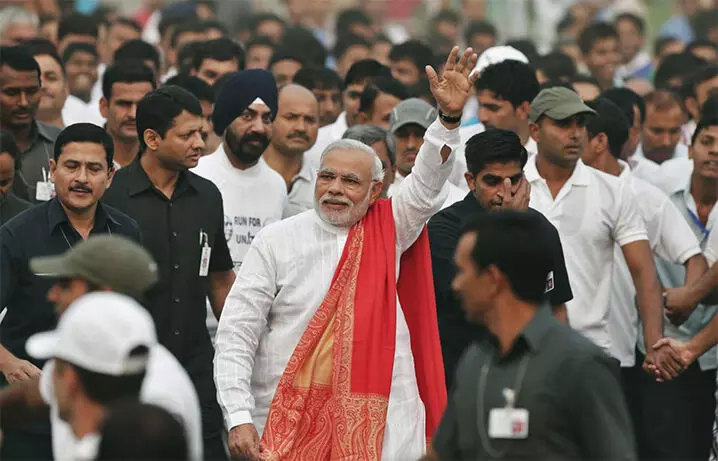
Narendra Modi’s 12 years in power mark a decisive shift from inherited hesitation to confident governance, strategic clarity and a wider effort to re-root India in its civilisational self
When he won a third consecutive term as Prime Minister in June 2024, it was already clear that Narendra Modi would eventually surpass Nehru’s tenure. Surpassing Nehru was never Modi’s goal. That line, that comparison is primarily for the analyst, the commentator and the researcher. In his more than a quarter century of being an elected Chief Minister and then Prime Minister, Modi set goals and targets to surpass himself and his visions.
When he won a third consecutive term as Prime Minister in June 2024, it was already clear that Narendra Modi would eventually surpass Nehru’s tenure. Surpassing Nehru was never Modi’s goal. That line, that comparison is primarily for the analyst, the commentator and the researcher. In his more than a quarter century of being an elected Chief Minister and then Prime Minister, Modi set goals and targets to surpass himself and his visions.
The “New India” of Modi’s vision and hopes echoes that of Swami Vivekananda. As a lifelong adherent of the Swami’s philosophy of transformative action, Modi’s driving inspiration is the Swami’s vision of a “New India.” Swami Vivekananda saw the emergence of a “New India” from the roots, from the margins of society, “…let New India arise…out of the peasants’ cottage, grasping the plough; out of the huts of the fisherman, the cobbler, and the sweeper. Let her spring from the grocer’s shop, from beside the oven of the fritter-seller. Let her emanate from the factory, from marts, and from markets. Let her emerge from groves and forests, from hills and mountains…” The rise of this “New India” is Modi’s talisman of governance and of empowerment. It has been evident each day, over these 12 long years.
If at all Nehru is to be invoked, it must be in the context of how Modi has undone the historic tangles and has righted the historic wrongs that were legacy leftovers of the Nehruvian era. Weak borders, hesitant national security approach, festering conflicts in the northeast, leaving the temporary 370 wall as if it was a permanent and indestructible structure, a foreign policy not driven by pragmatic strategic interest but rather directed by emotion, defence dependency lacking a roadmap for self-reliance, treating persecuted and displaced refugees from India’s neighbourhood as dirt to be tossed out, allowing India’s land and territory to be nibbled away progressively through ruse and coercion, pampering separatists and insurgents, treating poisonous ideologies such as Maoism and Naxalism with velvet-gloves, have all the corrosive hallmarks of the Nehruvian consensus.
Modi has conclusively addressed each of these in the last 12 years. Some he has completely undone; on some others the work is in progress with results showing at every step. From the abrogation of Article 370 to making India Naxal-free, from an increased focus on defence self-reliance to the passing of the CAA, Modi’s work at undoing the wrongs and hesitations of free India is his finest contribution.
Writing of the iconic French statesman Général Charles De Gaulle’s most enduring legacy, his biographer, the French journalist and historian, Paul-Marie De La Gorce, observed that “decolonisation will remain undoubtedly the most ineffaceable mark that” De Gaulle “brought to the history of the century.” One of the most impressive and impactful of Modi’s action-inspiring articulations has been the argument and demand for a comprehensive “decolonisation” drive in every field of national action. Modi has been relentless in identifying, recovering, mainstreaming and disseminating Bharatiya narratives and symbols that can drive the movement for a collective and comprehensive national decolonisation.
From re-introducing insignia of armed forces from history, to changing the framework of Padma awards, to restoring the religious-dharmic-cultural nodes and pillars of civilisational India, to commemorating icons and historic events, long forgotten and suppressed, such as the Janajati Gaurav Divas, Somnath Swabhiman Parv and the legacy of the mighty Cholas, to re-initiating Dhamma Yatras with Lord Buddha’s sacred Relics globally, to recovering India’s cultural heritage stolen and deported from her shores in the past, Modi has succeeded in galvanizing “decolonisation” as a “Jan Andolan” “People’s Movement” driven and led by society. This will also be counted among his most indelible imprint on the quarter century that is “Amrit Kaal.”
Each of his propositions in his decolonisation programme provokes us out of our comfort zones of thought. He sets a timeline; he does not leave these civilisational programmes open-ended. When he reminded us that 2035 will be the centenary of Lord Macaulay’s devastating “Minutes of Education”, and that “decolonisation” must be complete by then, Modi is setting an action-driven time-frame. He was articulating a goal that was achievable, that was civilisational and would be fundamentally transformative and enduring in its impact and effect.
Every civilisation and society that seeks to recover their cultural and civilisational essence must emphasise and focus on decolonisation – recovering heritage, texts, knowledge systems, evolving governance models, retracing global footprints, securing past civilisational space for strategic traction in the present, are some of the actions that define that recovery. Modi has initiated a comprehensive and wide-ranging recovery. It becomes evident when one closely looks at his actions and achievements over 12 years.
Many desperate soothsayers of the end of the Modi era had predicted in the summer of 2024 that Modi lacked the ability to run a coalition, just as they had surmised in 2014 that as a regional leader, Modi lacked a national and international depth and understanding. In 2014, and a decade later in 2024, while they still tried to prove their failed predictions, Modi proved that he was both an international statesman and a deft and skilful leader of a coalition.
In fact, no one except the political Modi baiters, many of whom are now eating back their words while staring at their own political demise, really believed that Modi was heading a coalition. He was seen leading and directing, with the same sturdy and inexhaustible energy and confidence, as he had set out to do in the summer of 2014. These last 12 years have been and continue to be a journey of civilisational recovery.
In his relentless pursuit of realising and securing India’s interests, Prime Minister Narendra Modi reminds one of the immortal words of Sri Aurobindo, words that continue to exude a mantric aura, uttered long ago, when India was under subjection and yearned for a new awakening “…There are times in a nation’s history when Providence places before it one work, one aim, to which everything else, however high and noble in itself, has to be sacrificed. Such a time has now arrived for our motherland when nothing is dearer than her service, when everything else is to be directed to that end. If you will study, study for her sake; train yourselves body and mind and soul for her service. You will earn your living so that you may live for her sake. You will go abroad to foreign lands so that you may bring back knowledge with which you may do service to her. Work that she may prosper. Suffer that she may rejoice.”
In the last 12 years, PM Modi has become the most perfect expression and manifestation of that ennobling and sacred injunction and exhortation.