The Viswaguru Imperative
- By : Anirban Ganguly
- Category : Articles
The idea of India as Viswaguru demands discipline, constitutionalism and national purpose—not rhetoric, disruption or the politics of anarchy
A glimpse of what it takes to transform India into Viswaguru was seen during the dark days of the pandemic, when Covid inundated the world and India stood out, radiating hope and succour. The Modi abusers had then taken the Indian vaccine, which Modi took first to reassure us all that it was India-made and safe. It saved India; it saved Modi’s haters and abusers. In developing one of the most effective vaccines, India outpaced many so-called developed nations and leading superpowers of the world. In keeping with her ideal of “Viswamitra”, India also supplied vaccines to a large number of smaller nations that had been left in the lurch by bigger powers. How can those who claim to know how to turn India into Viswaguru today forget those dark and uncertain days and the light shown then by Modi’s leadership?
Another glimpse of India’s potential to become Viswaguru was repeatedly seen over the last twelve years, when Modi ensured that Indians and Indian students were rescued to safety from war zones and difficult terrain. Operation Sindhu, in June 2025, evacuated 110 Indian students to safety from the Iran-Israel conflict zone. Another 290 MBBS students, mostly from Jammu & Kashmir and studying medicine in Iran, were evacuated in June 2025. The Vande Bharat Mission during the Covid period saw a large number of Indians being brought back to the country, with over 1.83 crore Indians having their travel facilitated. Operation Ganga, in February-March 2022, saw over 18,000 Indian nationals, mainly students, evacuated from Ukraine through 90 flights.
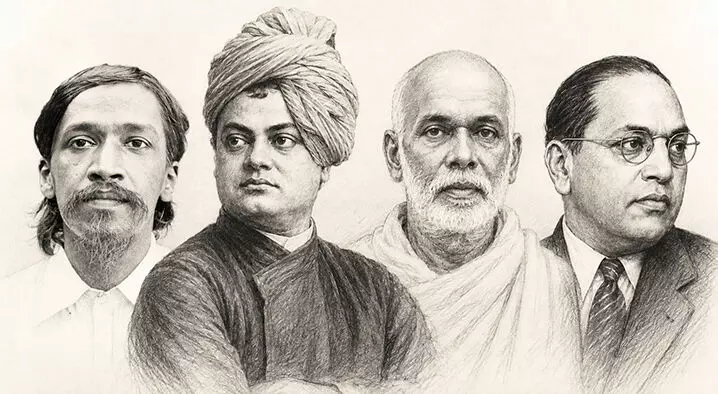
Sri Aurobindo renounced politics in his thirties and took to the path of his sadhana for India’s regeneration and human transformation. Swami Vivekananda was twenty-nine when he plunged into the sea at Kanyakumari and swam across the shark-infested stretch to meditate on the last rock at the confluence of the three seas, at the end of his countrywide travels as a parivrajak. It was here, while meditating on the plight of his countrymen and compatriots, who were downtrodden and under subjection, that he evolved a plan for India’s regeneration and went on to generate a storm in both the West and India. When Nanu Swami transformed into Sree Narayana Guru, descending from his intense penance on the Maruthwamala Hills, he was thirty-one. It was as Sree Narayana Guru that he founded the Sivagiri Mutt and led the historic and transformative educational, social and religious reform movement that has left a lasting and living imprint on the national psyche.
Each of these stalwarts represented Indian youth and was seen as a voice of liberation in his lifetime. Why were posters of Sree Narayana Guru, Sri Aurobindo, Swami Vivekananda and Mahatma Jyotiba Phule—all educational and social reformers, revolutionary thinkers and men of action in their era—missing from Jantar Mantar? Why were the images of Ishwar Chandra Vidyasagar, Raja Rammohun Roy, Netaji Subhas Chandra Bose and Mahakavi Subramania Bharati missing from the protest venue?
Is it because these personalities represented a line of thought and action centred on India’s rise and greatness? Was it because each of these icons embodied a duty-driven patriotism, an India-centred nationalism and a vision of social transformation? Was it because they spoke of strengthening India through social cohesion and national unity?
Those who professed to speak at the venue in the name of Babasaheb Ambedkar’s political and social philosophy were, in fact, betraying him. By pushing for the uprooting of the Indian Parliament, by negating constitutional methods, by calling for Modi’s death, by abusing his late mother, and by demanding that Modi be hanged, they were, in effect, advancing the “Grammar of Anarchy”. Babasaheb Ambedkar had warned against this tendency as early as 25 November 1949, in his final speech in the Constituent Assembly, when his mind “was so full of the future of our country.”
Cautioning against losing our independence once again through the “treachery and infidelity” of our own people, Babasaheb articulated his fundamental dictum—his philosophy on how to preserve India as a democracy “not merely in form, but also in fact.” “The first thing we must do is to hold fast to Constitutional methods of achieving our social and economic objectives. It means we must abandon the bloody methods of revolution… Where constitutional methods are open, there can be no justification for these unconstitutional methods. These methods are nothing but the Grammar of Anarchy, and the sooner they are abandoned, the better for us.”
Which icons do the Modi abusers, whom some tell us can make India Viswaguru, then follow or draw inspiration from? They reject Sri Aurobindo, remain silent on Vivekananda, and have betrayed Ambedkar. Who, then, are their idols?
Self-styled Sri Aurobindo experts who pat the self-styled Gen Z Modi abusers on the back and repose faith in their ability to make India Viswaguru must instead ask them to read, absorb and internalise, if at all possible, Sri Aurobindo’s advice to the students of the National College. His appeal to them to “Work that she [India] may prosper. Suffer that she [India] may rejoice…” remains relevant and striking across generations and decades.
That appeal, that earnest injunction, is the surest recipe, formula and ideal for India’s rise. It is the only counter to the Grammar of Anarchy and its false harbingers. It is the only authentic way for India to become Viswaguru.
Source: https://www.millenniumpost.in/opinion/excellence-needs-dharmas-guidance-670960