Nehru Was Against Bangladeshi Hindu Refugees Entering India Despite Then Bengal CM’s SOS, Reveals BJP Leader’s New Book
- By : Anirban Ganguly
- Category : Articles, Book Review
At a time when Prime Minister Narendra Modi has not only voiced his support for Bangladeshi Hindus and other minorities under attack in the neighbouring country but also given Sheikh Hasina safe refuge, a new book by BJP leader Dr Anirban Ganguly makes a sensational claim.
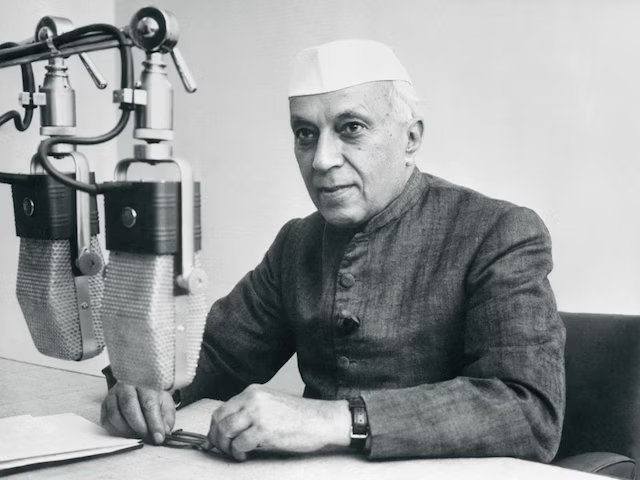
The book, which explores the journey from Partition to the Citizenship Amendment Act (CAA), claims that India’s first prime minister Jawaharlal Nehru was not just dismissive of the plight of Bangladeshi Hindus but almost a wilful party to their plight despite an SOS being sent by then West Bengal chief minister and Congressman Dr BC Roy.
WHEN NEHRU ‘DITCHED’ BANGLADESHI HINDUS
Ganguly, also the biographer of Home Minister Amit Shah, is coming out with his new book ‘From Partition to Progress: Persecuted Hindus and the Struggle for Citizenship’.
Giving graphic examples of how Syama Prasad Mookerjee had to raise the issue of Hindu persecution in East Pakistan in the Indian Parliament, Ganguly writes: “In the 1950s, Nehru began shutting every door on Hindu refugees. When the Chief Minister of Bengal, Dr BC Roy, pleaded with Nehru to open the doors to the wretched refugees, Nehru refused saying: “If we open the door, we will all sink”.”
Ganguly cites another instance of insensitivity on Nehru’s part where a delegation of Bengali Hindu refugees belonging to the Nikhil Vanga Bastuhara Karam Parishad (NVBKP) led by Gandhians and Congress leaders of East Bengal — Amritlal Chatterjee, Mahadev Bhattacharya, and Nagen Das — came all the way from East Pakistan to plead their case at the Jaipur session of the All India Congress Committee (AICC) in 1948. Most of them had fought the freedom struggle at the call of Mahatma Gandhi.
“They were stunned by the Prime Minister’s reaction. Nehru told them, point blank, that ‘the refugees were all foreigners’ and that the ‘Karam Parishad representatives better talk to the Foreign Bureau of the AICC’. Nehru had decided to look upon the refugees from East Bengal as foreigners — people who till the other day carried the Congress flag, fought for India’s freedom under Mahatma Gandhi’s leadership and were some of the faithful carriers of the Congress’s ideology and political programmes.”
CAA: RAHUL GANDHI CARRYING NEHRU’S LEGACY?
The author has recurrently used the Citizenship Amendment Act (CAA) — whose impact is huge particularly in West Bengal among communities like Matuas who have been demanding such a law for generations — to draw parallels between Nehru and Rahul Gandhi.
“Congress leader Rahul Gandhi pledged to oppose CAA ‘tooth and nail’. As this opuscule will show, Rahul Gandhi’s great-grandfather had consistently opposed the granting of citizenship rights to persecuted minorities from India’s neighbourhood. Nehru was especially opposed to and acerbic towards the Bengali Hindu refugees. It is known that the Congress, as a party, has always betrayed the Hindus of Pakistan and East Pakistan and later Bangladesh. It failed to keep its promise to protect them,” writes the BJP leader-cum-author.
There have been at least 140 mentions of CAA in the entire book. Ganguly sought to underline the Congress’s double standards on CAA, saying it is not just a “commitment” of Bharatiya Jana Sangh — BJP’s precursor — but also acknowledging Dr Manmohan Singh’s wish as a Leader of Opposition under the Vajpayee regime.
“Congress by opposing CAA has even forsaken its leaders and former Prime Minister Dr Manmohan Singh, Leader of Opposition in the Rajya Sabha, who while speaking on the Citizenship Amendment Bill 2003, urged the then Deputy Prime Minister and Home Minister of India LK Advani to take note of the plight of the refugees,” Ganguly says in the book.
Making a connection between Rahul Gandhi and Nehru, he wrote: “His political heirs today have actively opposed the conferring of citizenship on minorities persecuted and evicted from India’s neighbourhood. Nehru’s heirs whipped up emotions and attempted to generate a communal frenzy through a deliberate misinterpretation of the Act. In doing this, they displayed a colossal ignorance of partition history and a stony and disdainful indifference to the plight of the refugees who, for seven decades, have been living a near invisible existence.”
Ganguly is the chairman of Dr Syama Prasad Mookerjee Research Foundation, New Delhi. He is also a member of BJP’s National Executive Committee.