Congress’ Anarchy System
- By : Anirban Ganguly
- Category : Articles
25 years ago, political scientist and public intellectual Rajni Kothari spoke of the decline of the “Congress system.” Kothari spoke of the Congress becoming a “caricature of the Congress system”, in many ways a negation of it. He had famously coined the term “Congress System.” Kothari referred to the Congress’s “long-term decline starting from 1967 and continuing since…” The Congress, he concluded, was facing a kind of “nemesis.”
In the course of its long-term decline, the Congress lit fires and flashpoints across the country. From Kashmir to Tamil Nadu, to the northeast, the Congress system in decline left political, social, linguistic, caste, denominational and governance issues and challenges unattended. Often it has complicated situations and problems. It served the Congress’s politics to keep pots boiling and wounds festering. It was its way of deriving political mileage and capital.
Indira was dismissive of Parliament. She avoided serious discussion and was often impatient with its procedures and functioning. Rajiv, with his brute majority, often rammed through legislation detrimental to national health. The Shah Bano episode was one of the most glaring such instances. No one during Indira and Rajiv’s tenure spoke of “electoral autocracy”. Most of those who speak of an “electoral autocracy” in India today, were beneficiaries of the Congress system and were heavily co-opted by it. They continue to be loyal to it.
The long-term decline of the Congress continues to this day. Kothari’s erstwhile intellectual disciples, such as Yogendra Yadav, who have now emerged as one of the principal advisors of the Congress, are ensuring that the Congress’s long-term decline turns into a terminal decline.
From the “Congress system”, the likes of Yadav have now proposed an anarchy system, in which Parliament and Parliamentary democracy, electoral democracy, and elections become irrelevant. They seem to be proposing that matters of the Republic and of governance be decided on the streets and through street-fights.
Referring to Parliament as a “pigsty” was once a favourite pastime of Communists the world over. Indian communists reluctantly took to Parliamentary politics so that they could survive and keep afloat. Their fundamental ideological disdain for electoral and Parliamentary democracy, however, remained unchanged.
The CPI (Maoist)’s subversive strategies once spoke of dismantling the Parliamentary system and of overthrowing the Constitutional and democratic structure of India. There seems to be a convergence of such destructionist ideologies in the approach and style of the Congress’s politics today. The once mainstream Congress is veering to the fringe. It wants all issues to be settled on the streets and not in and through Parliament. The Congress is trying to reincarnate itself as a combined platform for the votaries of overthrowing parliamentary democracy.
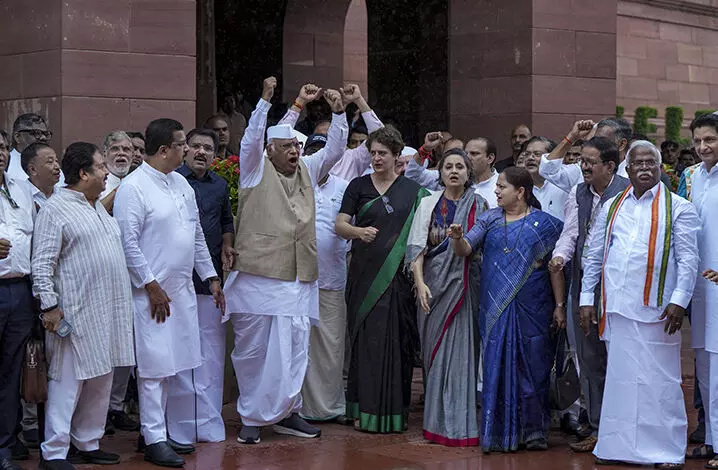
This comes across as a worrying sign. Worrying because the Congress’s pre-eminent agenda of removing Narendra Modi from power, does not hinge on the norms and structures of an electoral democracy. The Congress is seen to be increasingly trying to take recourse to the tactics of the putsch. Despite having the position of the Leader of Opposition, it displays disdain for Parliament and encourages and supports un-Parliamentary politics. Its support of anarchists who have infiltrated the students’ protest in Delhi and are trying to take control of it, reflects that disdain.
With their political capital fast depleting, the Congress depends on the fringe to bail it out. Its concern for students is just an alibi. It is a camouflage for their politics of wrecking Parliamentary democracy. The Congress has still not been able to recover from its defeat of 2014 and from its failure to unseat Modi in 2024. It has dumped and abjured all decency in its conduct; otherwise it would not have held a flash protest at the doorstep of the official residence of the Prime Minister of India, an act unheard of in the annals of free India’s democracy.
Students have always been a dispensable commodity for the Congress. The decade between 2004 and 2014 was plagued with repeated paper leaks, with several major national examinations, including the AIPGMEE (All India Post Graduate Medical Entrance Examination), AIEEE (All India Engineering Entrance Examination), and CBSE Board examinations being compromised.
Congress paid no attention to these systemic failures, and instead allowed the examinations to continue, while limiting the investigations. No comprehensive legal or legislative framework was put in place to address the rot. Just as in defence deals, the Congress it appeared to many, seems to have fingers in a number of paper leak cases and rackets as well.
A dig into the near past reveals how over 100 pan-India examination leaks occurred in the heydays of the Congress and its allied parties. Starting with the Armed Forces Medical College examination (AFMC) paper in 1972 to the Railway Recruitment Examination of 2013. In state after state, ruled by the Congress in the past, paper leaks had become normalised. The list of paper leaks, all pointing to the Congress’ failure or complicity, as one takes it, is a long one.
Despite being urged to, despite the issue being repeatedly taken up, the Congress did nothing to stem this disease. Examination paper leaks were also routine in states ruled by parties allied to the Congress or later, part of the INDI alliance. The Trinamool Congress’s record has been a shocking one. Mamata Banerjee’s government presided over the WBSSC Teachers Recruitment (SSC Scam) which saw 26,000 families affected and hundreds of crores being amassed by the party’s top leadership. Her TMC continues to be a valued ally of the Congress. The Congress and its allies had kept silent on that devastating issue. They signalled support to the TMC.
The UPA’s failed decade 2004-2014, saw no central law or agency being introduced. A dedicated central anti-paper-leak statute was absent; no national testing agency was set up. The elaborate and fine-tuned monitoring system that has been put in place today by the Modi Government, was absent or ignored during the Congress decade. A detailed debate in Parliament today on the issue will also expose the Congress’s apathy over decades in trying to fix this national challenge.
In line with his pledge to plug loopholes and to usher in systemic cleaning, PM Modi established the National Testing Agency in 2017. It was further restructured in 2025 into focusing only on entrance examinations for higher education institutions. In 2024, Parliament enacted the Public Examination (Prevention of Unfair Means) Act. It was India’s first dedicated law against paper leaks and organised cheating. The provisions were stringent, with imprisonment and fines upto Rs 1 crore for those who traded future of students. What prevented the Congress from bringing such legislation in its fifty years of running India? What prevented the Left parties, with their so-called sense of social justice, from forcing the UPA from introducing legislation to address the challenge.
Concern over medical entrance examinations in 2024 saw the Modi Government form an empowered committee headed by one of India’s most respected scientists K Radhakrishnan. The K Radhakrishnan Committee recommended deeper and more fundamental reforms such as stricter accountability mechanisms for examination functionaries, SOP for the secure and safe transportation and custody of question papers, improved grading and monitoring of examination centres, a stronger district-level coordination, facial biometric authentication and live photography.
Widening the enforcement net, action was swift on the conspirators of the leak. The case was handed over to the CBI, registering an FIR; a multi-state raid led to the arrest of 13 people, including a doctor and a coaching-institute faculty who were identified as the kingpins. 24 key suspects were also handed over to the central agencies, and the investigation remains live. From next year, the tests are set to be held in the Computer Based Test (CBT) mode. PM Modi’s announcing the fast-track courts and further strengthening the anti-paper leak law are the latest measures in a long series, aimed at decisively and comprehensively addressing this challenge.
The Congress and the proponents of the “Anarchy-System” do not actually want an enduring rectification of the flawed system. They do not intend to discuss India’s educational scenario in Parliament. They want, instead, to brawl out issues that concern India’s future and her youth, on the streets. They want to lay the first bricks of the “Anarchy-System.” That attempt must be exposed and opposed.