Jhalmuri in Jhargram: The moment the Modi wave peaked in Bengal
- By : Anirban Ganguly
- Category : Articles
For over 12 years these narrative peddlers have not been able to find or fix a pattern in PM Modi’s public comportment. (Moneycontrol)
Political pundits have been working overtime to analyse the BJP tsunami that swept West Bengal. The shock of the magnitude of the BJP’s victory, for those who kept parroting that it would be a neck-and-neck battle, and that the TMC would have an edge, has been resounding. Recovery from it seems to be a long-drawn exercise and may only be possible after much therapeutic support. Among the many factors that stand out as reasons for the BJP sweeping West Bengal and for the overwhelming support that it earned from people across the state, one stands out and stands apart.
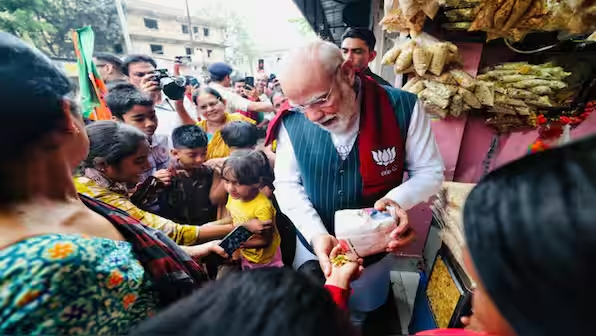
The Jhalmuri in Jhargram was the crème de la crème. That was when the Modi wave peaked, inundating his stunned opponents. All that they could do was hurl expletives at him, while the people of West Bengal, that sultry evening, had completely accepted and absorbed Modi as one of their very own.
Prime Minister Narendra Modi connected with the people of West Bengal like no other Prime Minister before him. His roadshows, the 15-kilometre one in Siliguri being the most historic, his campaign and connect with people in the searing heat of Rarh-Banga and Purulia, his silent cruise on the Hooghly in a local boat, his endearing conversation with the boatman, his Puja at the iconic and yet very local Thanthania Kali Bari, established in the early 1700s, so intrinsic and integral to the daily life of Kolkata and of Bengalis, deeply bound him to the Bengali psyche, which saw in him an offering of hope and a way out.
PM Modi’s deep and umbilical connection to the Ramakrishna Mission and the Ramakrishna Order has constantly kept him in touch and linked him with the deeply spiritual and religious essence of Bengal. It has also endeared him to the wide cross-section of Bengal which worships Sri Ramakrishna.
The 2026 West Bengal election indeed saw a Jhalmuri wave. In fact, the final push was PM Modi’s unscripted, unplanned break at the local Jhalmuri shop in Jhargram. The Jhalmuri stopover is integral to Bengalis. The stopover or break, as it is referred to, can happen anywhere, and at any time. It doesn’t have specified hours; the craving for it can arise at any moment. It can arise in trains, in bus stands, outside college or university campuses, during shopping breaks, during bus rides, or while walking along the Hooghly or taking a boat ride.
Whether it is the iconic 8B Bus Stand pavement, or the Jadavpur University pavement, whether it is the “Boipara” in College Street or the Gariahat market, whether it is the Maidan or Dharmatala-Esplanade, or the various towns across West Bengal — from Berhampore, Krishnanagar, to Siliguri and Darjeeling, from Gosaba and the Sunderbans to Junglemahal — the Jhalmuri is ubiquitous and conspicuous. When Bengalis travel outside Bengal, that craving, the Jhalmuri impulse, keeps popping up, leading one to look for Jhalmuri. Jhalmuri is in fact found across India. Its essence remains the same; only the region, the climate, the district adds a special flavour to it.
From Kovalam to Marina, from Rameshwaram to Puri, from Vizag to Somnath, from Chowpatty to Digha, Jhalmuri can be spotted and savoured. For PM Modi, who has trudged the length and breadth of India, this link is an experienced one. Among the culinary specialities that unite Indian taste, Jhalmuri comes across as one of the most popular. It cuts across cultural divides; in every region and climate, it maintains its popularity and niche. As a symbol of India’s oneness amidst her diversity, Jhalmuri is an outstanding symbol. Never underestimate its standing or the power of its symbolism.
The “Nepo-kids” of Indian politics, deracinated as they are, know little of Jhalmuri’s deep significance. They have not tasted it, most are oblivious of its existence, and the manner in which it is served, in the proverbial “thonga”, will repel them, addicted as they are to sanitised five- and seven-star parlours and lounges. Modi has come up the hard way, has lived the hard life; he naturally identifies with Jhalmuri and its seller, the seller in turn connects with him. He knows that Modi understands and savours the taste of Jhalmuri and also the struggles of its seller.
Jhalmuri has many flavours and many tangs, yet the onion-mix, sprinkled and mixed, is the most popular and dominant one. PM Modi’s natural insistence that he has it with “pyanj”, with onion, when asked the usual question that every Jhalmuri seller asks, is a line that every Bengali, who munches and digs into Jhalmuri, utters, repeats and insists upon!
The false narrative peddlers were left aghast; they were astounded to know that PM Modi eats “pyanj”. It did not fit into the image of the Prime Minister that they wanted to force down the Bengalis’ throats — that of a vegetarian Modi, who even shirks onion. It was a lie that they kept broadcasting. They said if PM Modi comes to power in Bengal, he would stop your pyanj and maach. The Jhalmuri with a liberal mix of onion completely offset that narrative, to the chagrin of the false proponents.
For over 12 years these narrative peddlers have not been able to find or fix a pattern in PM Modi’s public comportment. Just when they think they have decoded him, he springs a new angle. The Jhargram Jhalmuri was just that moment. While the Nepo-kids of Indian politics, after a hard day’s political campaign, find one thinly attended public meeting in which they utter inanities enough to tire them and then chill out in exotic climes at five-star rates, PM Modi pulled out a Rs 10 note, bought his Jhalmuri, shared it with a few of those who were glued to him, and relaxed with those with whom he has spent a lifetime — the hoi polloi, the subaltern and the marginal.
Buying the Jhalmuri with a Rs 10 note is near compulsory. The seller and the buyer know that this is the usual ceiling; only those who are regular with it know it. With great ease and naturalness, he must have done it thousands of times already, PM Modi pulled out his Rs 10 and got hold of his Jhalmuri thonga. Modi’s ease, naturalness, avidity and affinity for Jhalmuri struck a deep chord in the Bengali psyche. Bengali women across the state, the country and the world rejoiced, “Modi ji too likes and eats Jhalmuri,” he must therefore be of Bengal and a Bengali!
PM Modi’s exclamation, “Haan, pyanj khaate hain. Dimag nahi khaate bass”, were expressions with which the overwhelming majority could very genuinely identify. The expression “matha kheo na”, “don’t eat my head”, is a common endearing expression used for light repartee or a loving rebuke, especially by wives and mothers across Bengal.
That evening, the “Modi Wave” had gained decisive momentum and shape in the form of the Jhalmuri in Jhargram. Bengal took him to heart, while his political opponents, unable to fathom what hit them, flabbergasted, frothing, clenching fists, could only hurl howls, rueing that both Bengal and Modi had left them behind.