Icons Congress Chose to Ignore
- By : Anirban Ganguly
- Category : Articles
PM Modi’s commemorative push has restored national icons and legacies long sidelined under Congress rule
While looking back at Prime Minister Modi’s 12 years and his total of 25 years up until now, one dimension that is striking is his commitment to commemorating and upholding the legacies of our icons, thought leaders, social reformers and epoch-makers.
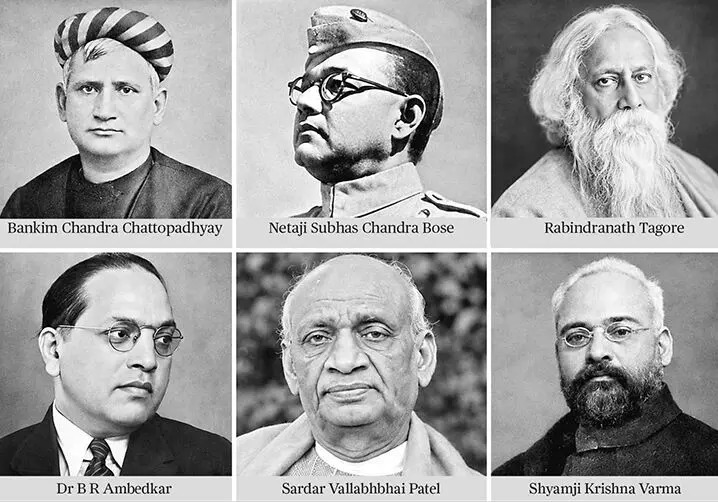
Modi’s tribute to Netaji Subhas Chandra Bose through various historic initiatives, his tribute to Sardar Patel through the Statue of Unity, and the grand memorial to Dr Babasaheb Ambedkar have remained some of the finest tributes to these icons, correcting deliberate wrongs. Successive Congress governments ignored Patel’s contribution and tarried over erecting a memorial to Babasaheb. It was a calculated move to try to obliterate them from our collective memory.
As Chief Minister of Gujarat, Modi’s effort to successfully repatriate the ashes of the iconic revolutionary nationalist Shyamji Krishna Varma in 2003, 56 years after Independence and 73 years after Varma’s death, was one of his finest moments.
Many of those whose ideals and vision of India Modi commemorated and disseminated were given short shrift by the Congress. I mean the Congress of the past, because the Congress of today is only a pale version of its past and is mostly identified with vulgarity of thought and subversive action.
Vande Mataram’s centenary was not observed in 1975. Indira Gandhi and her Congress were busy imposing the Emergency, clamping down on human rights, snuffing out lives and hauling citizens, journalists, artists, students and political activists into prison. Among Indira’s preoccupations was also her obsession with ensuring that Jaya Prakash Narayan’s health deteriorated in detention.
Indira and her Congress did not have time to celebrate the centenary of Rishi Bankim’s high vision of the Motherland as a free, strong and united entity. The cry “Vande Mataram” must have reminded Indira of the freedom movement, of the demand for a free country, and she could scarcely allow that to happen.
1975 was Sardar Patel’s centenary year. Naturally, it was ignored. How could Indira, in the midst of the Emergency, commemorate and pay tribute to Sardar Patel? Moreover, like her father, Indira too harboured a deep antipathy towards Sardar Patel and his legacy. It was best buried and forgotten. No major commemoration or remembrance marked Patel’s centenary. It fell to Modi to rectify that deliberate omission by erecting one of the greatest memorials to Patel — the Statue of Unity.
Because of the Congress-led UPA-I government’s extreme callousness, Gurudev Rabindranath Tagore’s Nobel Prize medal, stolen in November 2004, could never be retrieved. One of the biggest blots on our national life, it showed the pathetic and insensitive side of the UPA and the Sonia Gandhi-led Congress, which otherwise never lost a chance to project itself as the custodian of the legacy of Indian icons. No serious efforts were made to retrieve the medal by the Congress and the Left and to erase our collective sense of shame. Years later, by ensuring the UNESCO heritage tag for Tagore’s beloved Santiniketan, Narendra Modi offered a nation’s gratitude.
The Congress, from Nehru onwards, displayed an intense antipathy towards Netaji Subhas Chandra Bose. The Congress’s first family went out of its way to ensure that Netaji’s legacy was never commemorated in free India. Unthinkable as it may appear now, veteran Forward Bloc leader and Member of Parliament, the late Samar Guha, in his Netaji — Dead or Alive, tells us how, during his visit to Singapore in 1946, where he met Mountbatten, Nehru “refused to attend the INA martyr memorial ceremony organised at Singapore” by the INA veterans. Mountbatten had got the INA Martyr Monument in Singapore demolished, and Nehru, after initially agreeing, had refused to attend the ceremony at the spot where the memorial once stood.
Guha records that after “his return from Singapore, Nehru never uttered a word about Netaji for over a decade even after he became Prime Minister of India.” Till the fifties, Guha writes, All India Radio “was instructed not to cover any special talk on Netaji or broadcast any news about Netaji’s birthday, exceeding a few minutes. All army barracks were prohibited from displaying any portrait of Netaji.” This ban “continued for years even after the withdrawal of British power.”
In 1959, when Guha requested Nehru to take the initiative in rebuilding the monument to Netaji, saying that Indians in Singapore wanted the Indian government “to take some initiative in this matter,” Nehru’s curt reply was that “this was a matter between the Indians in Singapore and the Singapore Government. If they agreed, we would not object, but we did not think it desirable to take any initiative ourselves.”
Compare this hatred with Modi’s reverence and gratitude for Netaji and his legacy.
Each of these icons whom the Congress revels in ignoring and marginalising was against anarchism. Their vision was that of a free, united and great India — attributes that the Congress of today neither accepts nor comprehends.