A Democratic legacy of 75 years
- By : Anirban Ganguly
- Category : Articles
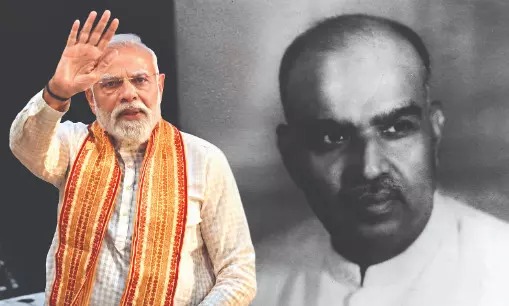
Founded by Syama Prasad Mookerjee in 1951, the Bharatiya Jana Sangh sought to establish an alternative political force rooted in Indian nationalism and constitutionalism
Seventy-five years ago, on October 21, 1951, when he was fifty years old, Dr Syama Prasad Mookerjee founded the Bharatiya Jana Sangh as a new and alternative pole of Indian politics. The Jana Sangh was founded after Independence and did not derive its inspiration from foreign thinkers, philosophers and ideologues. It spoke of establishing “Dharma Rajya, i.e., Rule of Law” and of “rebuilding Bharat on the basis of Bharatiya Sanskriti [Indian Culture] and Maryada [Values].”
October 21 was a significant date in the annals of India’s freedom struggle. It was on that day in 1943 that Netaji Subhas Chandra Bose proclaimed the formation of the Provisional Government of Free India. In its aspiration to make India self-reliant, resilient and great, the Bharatiya Jana Sangh, Dr Mookerjee is said to have observed, would carry forward the spirit, essence and tradition of that sacred proclamation.
In a flourish of unparliamentary and undemocratic rhetoric, the Prime Minister of India, Pandit Jawaharlal Nehru, had vowed to crush the fledgling Jana Sangh. To resounding applause at a huge public meeting that he addressed at Delhi’s Gandhi Grounds that evening, Dr Mookerjee countered that he would crush that crushing mentality.
The new party’s symbol was the “earthen lamp”, or “Pradip”, symbolising earthiness and rootedness and expressing the civilisational and cultural ethos of Bharat. The Pradip was also an object found in almost every home across India. It demonstrated the new party’s determination and zeal to reach out to every home and family. Of the humble earthen lamp, Dr Mookerjee said that it would try to carry the “light of hope and unity, faith and courage, to dispel the darkness that surrounds the country.”
By 1951, Syama Prasad Mookerjee had already left his imprint on the politics of his state, West Bengal, and of India. He had spearheaded the movement that led to the creation of West Bengal, and besides resigning from the Nehru Cabinet in protest against Nehru’s duplicitous policy towards Bengali Hindu refugees, he had taken Nehru on when the latter sought to clamp down on free speech and expression.
It is ironic to see Nehru’s progeny wave the Constitution like Mao’s “Little Red Book” when it was Nehru himself who had determinedly tried to crush free speech and expression within fifteen months of the Constitution coming into effect.
The First Amendment debate perhaps remains unparalleled in modern legislative history. It is said that Dr Mookerjee’s interventions were so convincing that the Congress benches responded with thumping approval of his arguments and ripostes.
Dr Mookerjee refused to treat the Constitution as a scrap of paper. “While we constantly watch the provisions of our Constitution and see to it that nothing is done which may stand in the way of the fulfilment of the right aspirations of the people of this country,” he countered Nehru, “we will not treat it as a scrap of paper. If we ourselves show disrespect to the Constitution, or proceed to amend it because there is some small attack from this quarter or some suspicion thereon from that quarter, because of embarrassment caused to the powers that be, then we shall be sounding the death-knell of democracy in this country.”
Dr Mookerjee’s mobilisation of opinion within the legislature and outside was so robust and meticulous that 77 Congress MPs asked Nehru for a conscience vote on the Amendment when it would be discussed. A shaken Nehru was compelled to introduce the qualifying term “reasonable” to the draconian restrictions he had planned to ram through. Dr Mookerjee, responding to this, said that “by adding the word ‘reasonable’ to restriction a big change has been made. And in fact, it is the triumph of those who either opposed the Bill when it was originally introduced, whether inside the Congress party or outside or those who criticised its provisions.”
Nehru, and later Indira and Rajiv, would treat the Constitution as a scrap of paper. The Jana Sangh, and the BJP after it, never did that, whether in opposition or in power.
Describing the ideals, philosophy and politics of the Jana Sangh, Dr Mookerjee said that the party was open to all citizens of India and that while India represented a “unique diversity”, the people must be united by a bond of fellowship and understanding, inspired by a deep devotion to the spirit of a common motherland.
The Jana Sangh based its politics and struggle on such a sublime yet concrete nationalism. Devotion to India and to India’s unity was the new party’s governing creed and faith.
The first general election was around the corner. Nehru was out to crush the Jana Sangh, and Dr Mookerjee and his new team of office-bearers and workers plunged into the electoral fray. Deendayal Upadhyaya, then general secretary of the party’s Uttar Pradesh unit, was among them.
One of his biographers, Proshanto Kumar Chatterji, describes Dr Mookerjee’s campaign against great odds. “After vigorously campaigning for days and weeks together and addressing a dozen meetings on some days without even the minimum of comforts, Dr Mookerjee could give very little of his time and attention to his own constituency”, Calcutta South-East. He issued an appeal on December 1, 1951, “regretting his inability to approach voters personally however much he wished for it and hoping for their support.”
Congress had spread canards against Dr Mookerjee, especially among the 23 per cent Muslims of his constituency. It projected the Jana Sangh “as their worst enemy.” It had also “put up one of Calcutta’s richest men [Mriganka Mohan Sur] as a candidate and committed all their vast resources to their election campaign.” The Communist Party of India (CPI), not to be left behind, also put up a candidate against Dr Mookerjee.
Dr Mookerjee “lacked financial resources. But the voters, conscious of his services to Bengal and India”, made him win with a thumping majority. The Nehru Congress had left no stone unturned to defeat Dr Mookerjee and Dr Ambedkar in the first general elections. By winning three seats and bagging 3.06 per cent of the votes, the Jana Sangh succeeded in securing the “national party” tag. It never forfeited it.
Contrary to what ideologues of the Left have propagated, the Jana Sangh had a multi-layered societal focus from the beginning. The BJP carried on that tradition, vastly expanding its political footprint and reach. Rather than proving to be a dampener, the results of the first general election proved to be a boost for the new party.
Within days of the election, in early 1952, the BJS Central Working Committee met in Delhi and decided that the workers of the Jana Sangh would take up “the more important work of organising a network of Jana Sangh bodies all over the country and through them implementing constructive programme for the cultural, social and economic regeneration of the deprived sections of Indian society and for building up a stable political structure on the basis of democracy.”
The political programme and roadmap thus drawn up focused on work “among Harijans and other backward classes” with a “view to absorb them into the mainstream on the basis of perfect equality”; “among labourers” with a view to “raising their standard of living, securing for them an equitable share in the profits of industries”; among women, to make them realise that “they were equal partners in the governance of their country and persuading them to augment their family income by taking to cottage industries”; and among farmers, to ensure, among other things, “improved means of working and raising their standard of living.”
In Parliament, leading the Jana Sangh, Dr Mookerjee became the “Chief Opposition Leader”, as Deendayal Upadhyaya described him. Jurist and expert in international law Lanka Sundaram, elected as an independent member of the first Lok Sabha from Visakhapatnam, observed that “the attention bestowed” on Dr Mookerjee’s “intervention by the House was compared to that which is available to the Leader of the House, Sri Jawaharlal Nehru.” This was not due to the Congress’s largesse but because of Dr Mookerjee’s own parliamentary standing, dexterity and acumen.
Hirendra Nath Mukherjee, CPI member of the Lok Sabha from Calcutta-North, described Syama Prasad Mookerjee as an “outstanding person” and the “most accomplished perhaps among Indian parliamentarians so far.” Of “parliamentary acumen”, Hiren Mukherjee noted that Syama Prasad possessed it in greater measure than Nehru.
His deft parliamentary acumen led Dr Mookerjee to stitch together a wide opposition bloc. It comprised 32 Members of Parliament, including six from the Rajya Sabha. The National Democratic group or party had Christian and Sikh members, as well as members from across India. It had support from MPs from southern India, including Tamil Nadu, Kerala and Andhra Pradesh, and also from Odisha, Punjab, Madhya Pradesh, Rajasthan, West Bengal and Uttar Pradesh. The Ganatantra Parishad of Odisha, Hindu Mahasabha, Tamil Nadu Toilers Party, Lok Sevak Sangh, which had won from Purulia, and independents from Nellore (Andhra Pradesh), Kerala and Tamil Nadu supported it.
Among the notable leaders who formed part of the bloc were the legendary R N Singh Deo, then representing the Ganatantra Parishad from Kalahandi; V G Deshpande of the Hindu Mahasabha from Guna, Madhya Pradesh; N B Khare of the Hindu Mahasabha from Gwalior; N C Chatterjee of the Hindu Mahasabha from Hooghly, West Bengal; Sardar Hukum Singh of the Akali Dal, elected from the Kapurthala-Bhatinda constituency; Annie Mascarene, an independent member from Trivandrum; U M Trivedi of the Jana Sangh from Chittor, Rajasthan; and Acharya Deva Prasad Ghosh, the Jana Sangh’s member in the Rajya Sabha. Each of these leaders had already made their mark in India’s public life. The bloc became the third-largest group in the Lok Sabha.
All these leaders, with Dr Mookerjee in the lead, contributed equally, if not more, than Pandit Nehru and his Congress to establishing the parliamentary and democratic norms of free India.
Dr Mookerjee’s opponents witnessed his remarkable use of the parliamentary system, without ever questioning or denigrating it, in putting together a formidable democratic and parliamentary opposition bloc. In fact, in him, almost every one of them found a parliamentary mentor, a “friendly veteran” of parliamentary norms.
The opposition, recorded Hiren Mukherjee, “numerically at bay, made up for the deficiency, more often than not, with forensic flair which the government party could not quite match…”
Writing on Dr Mookerjee’s last birthday, in July 1952, Pandit Deendayal Upadhyaya described him as the “Chief Opposition Leader”. In “accordance with the rules made by the Lok Sabha Speaker,” wrote Upadhyaya, “Dr Mookerjee may not have been accepted as the leader of the opposition but all Members of Parliament, not only those from parties opposing him but all parliamentarians consider him to be their leader.” There is “only one individual whom every Member of Parliament is eager to listen to. Whether opposition members or Congressmen,” Upadhyaya recorded, “all are present in the house when Dr Syama Prasad Mookerjee begins his speech. The visitors’ gallery is fully packed…”
Wittiness, marshalling of facts, adherence to parliamentary decorum, sticking to the allotted time, sarcasm devoid of malice and evidence-based interventions were the hallmarks of Dr Mookerjee’s parliamentary performance.
Deendayal Upadhyaya best describes the impact it had on the Congress members of Parliament: “Even Congressmen accord due importance to what Dr Mookerjee says, because he articulates the language of their hearts. Their innermost feelings, which they dare not express fearing Nehru’s wrath and the chains of party discipline, find expression in Dr Mookerjee’s speeches and it is but natural that their hearts are drawn to it.”
The flame of the Bharatiya Jana Sangh’s core ideals was kept alive over decades through an indefatigable struggle by the likes of Pandit Deendayal Upadhyaya, Atal Behari Vajpayee and L K Advani. Through Narendra Modi, the Jana Sangh and Dr Mookerjee’s core vision and aspirations saw fulfilment. It is the vision of an India united by the spirit and framework of the Constitution, an India where the vision and ideal of devotion to a common motherland drive the achievement of national goals.
Looking back over 75 years, the Jana Sangh’s most profound and fundamental contribution was to have firmly planted the foundations of democracy, constitutionalism and uncompromising patriotism deep into free India’s polity and psyche.
That legacy and its continuing influence do not need lessons on democratic conduct and constitutionality from those who have repeatedly violated that sanctity and sacred trust.