At 150, Sarat Chandra Still Speaks
- By : Anirban Ganguly
- Category : Articles
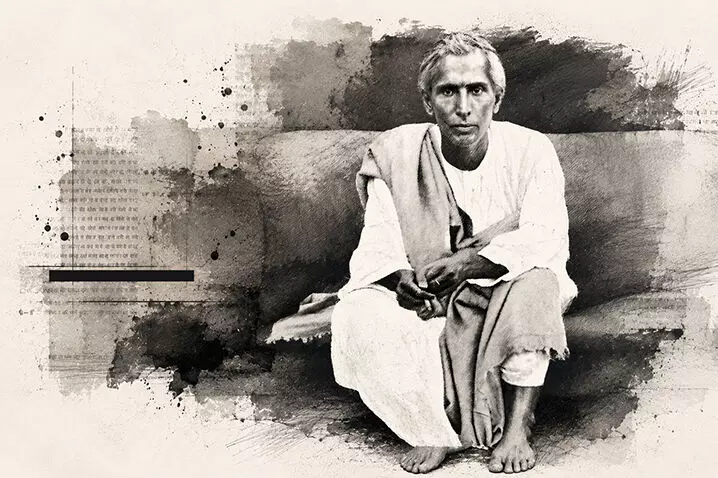
As India marks the 150th birth anniversary of Sarat Chandra Chattopadhyay, the timeless novelist continues to illuminate the hopes, struggles and moral dilemmas of ordinary people
2026 is an auspicious year for West Bengal and for Bengal’s cultural, spiritual, educational legacy and her history of nationalism and for India.
It marks several milestones connected with the life and contributions of such iconic personalities who, while being staunch Bengalis and proponents of Bengali culture, were also equally staunch and proud Indians and proponents of Indian nationalism and of Indian culture. They were spokespersons for Bengal’s greatness and of India’s greatness; they wrote describing the uniqueness of Bengali culture and of the greatness of Indian culture. They never made a distinction between Bengal’s greatness and the rise of India. This consciousness and public perception and stance had gradually diluted and withered away from Bengal’s public space and discourse in the last five decades.
This year marks the 150th year of Rishi Bankim’s “Vande Mataram”, and the historic change in West Bengal comes at an opportune time. Vande Mataram is now being sung without inhibition across the state, in schools, public functions and official occasions. It is being sung spontaneously by people with a sense of liberation.
2026 also marks the 200th birth anniversary of one of the greatest icons of nationalism, swadeshi and Atma nirbharta, Rishi Rajnarayan Bose. Rishi Rajnarayan Bose, was one of the tallest thought-leaders and reformers of his era, one of the brightest figures of the Bengal renaissance, a staunch nationalist, and among the earliest advocates of Swadeshi and self-reliance. He was a prolific author and towering thought-leader of his era and his book, “Hindu Dharmer Shresthata”, became one of the most widely read and debated works of his time. Rajnarayan Bose was also Sri Aurobindo’s grandfather, and that is why in later years he was also referred to, especially by Bipin Chandra Pal, as the “grandfather of Indian Nationalism.”
Pal writes that it was under Rajnarayan Bose’s inspiration that the Hindu Mela was started “a full quarter of a century before the Indian National Congress thought of an Indian Industrial Exhibition.” Historian Nemai Sadhan Bose, in his classic “Indian Awakening and Bengal” writing of the Hindu Mela, observes that “a significant feature of the national movement in Bengal towards the end of the nineteenth century was the growth of what is known as the New Spirit. The spirit of self-help and the emphasis on the necessity of building up Indian industries, arts and crafts were first evident in the annual sessions of the ‘Hindu Mela’.
This year also marks the 125th birth anniversary of Dr Syama Prasad Mookerjee. Among the most historic contributions that Dr Mookerjee made was the creation of West Bengal. As leader of Bengal and of the Bengali Hindus, he prevented the entire Bengal from being included in Pakistan and fought for the creation of West Bengal. That there exists West Bengal today is because of Dr Mookerjee’s farsighted leadership. For the first time since the creation of West Bengal, June 20, the day the Bengal Assembly had voted for the creation of West Bengal in 1947, will be officially observed this year as “West Bengal Foundation Day”, signifying a long-awaited tribute to one of its greatest and most ardent proponents.
This year also marks the centenary of one of the greatest Bengali cine superstars, Uttam Kumar, often regarded as one of the greatest actors of Indian cinema, who dominated the Bengali film industry between the 1950s and 1970s. This year, thus, offers us ample scope both in Bengal and nationally to commemorate these personalities. This is especially true in West Bengal, since the state has seen a positive change. It is a change which believes in commemorating, disseminating and preserving the legacies of these Bengali icons and thought leaders.
For us, it is also significant that this year marks the 150th birth anniversary of one of the most iconic Bengali writers, Sarat Chandra Chattopadhyay. Very few Indians would there be, who would not have read Sarat Babu’s novels in translations and would not have been moved by his stories or shed tears over them. If literature can unite, if language and emotions expressed in one language can connect minds and hearts across continents and countries, then Sarat Babu’s works, after that of Gurudev Rabindranath Tagore, stand out as the most outstanding.
In his lifetime, Sarat Babu has achieved a status few novelists had achieved. Long after he has gone, his stories are still discussed, commented upon, written about and typecast into movies and plays.
On seeing Sarat Chandra’s photograph, Sri Aurobindo remarked that he had a “large intelligence, an acute and accurate observation of men and things and a heart full of sympathy for sorrow and suffering. Too sensitive to be quite at ease with the world…”
Of Sarat Babu’s writings, Gurudev Rabindranath Tagore wrote from his perch “Uttarayan”, in Santiniketan, in March 1935, that Sarat Chandra “has guided Bengali novels nearer to the spirit of modern world literature” and that “he has imparted a new power to our language and in his stories has shed the light of a fresh vision upon the too familiar region of Bengal’s heart revealing the living significance of the obscure trifles in people’s personality. He has achieved the best reward of a novelist: he has completely won the hearts of the Bengali readers.” Sarat Babu eventually won the heart of India too.
Later, a few months before Sarat Babu passed away, in January 1938, Gurudev Tagore offered a most moving tribute to him at a felicitation organised in Calcutta. He said that like the astrologer who dives into the deep skies and discovers various stars and constellations and their deeper configuration and effect, Sarat Chandra’s eyes have plunged into the deep mysteries of the Bengali soul. His fascinating creations, describing the various dimensions of life, have enabled Bengalis to deeply know themselves. No other writer has been welcomed in the heart of Bengal as he has been…”
Famous Bengali poet and singer Dilip Kumar Roy, son of the illustrious poet-composer Dwijendralal Roy, who composed the immortal ode, “Dhana Dhanye Pushpe Bhora, Amader ei Basundhara,” translated Sarat Babu’s famous novel “Nishkriti” (1917) in English in 1944, with Sri Aurobindo himself helping him with and revising the translation. The translation used Gurudev’s assessment of Sarat Chandra as a preface. It brought out a unique combination, in which Sarat Chandra’s novel was translated, revised and introduced by three of Bengal’s greatest sons, Gurudev Rabindranath Tagore, Sri Aurobindo and Dilip Kumar Roy. The translation was dedicated to the legendary teacher-statesman-philosopher Sarvepalli Radhakrishnan. Radhakrishnan, who taught at Calcutta University between 1921 and 1932, had absorbed and witnessed one of Bengal’s finest eras led by stalwarts such as Tagore, Sarat Babu, C.R.Das and Asutosh Mookerjee, among others.
In his assessment of Sarat Chandra, Dilip Kumar Roy movingly writes that Sarat Chandra’s novels were “shot through with the life-throb and truth-throb that only intimate experience of suffering and squalor can inspire.” None has known Sarat Chandra, writes Dilip Kumar Roy, “who has known him only as a spectator of life: he was intrinsically, a seeker after the hidden truths that life so often hurtles past unheeding.”
One can continue writing about many facets of Sarat Chandra’s life and the way he immortalised himself in the Bengali cultural psyche. But let me end with one historic link. Sarat Chandra Chattopadhyay grew close with Asutosh Mookerjee’s family. Young Syama Prasad Mookerjee, his elder brother, later Justice Rama Prasad Mookerjee, and their younger brother, the famous travelogue writer, Uma Prasad Mookerjee, developed a close bond with him, inspired by their common interest in and pursuit of Bengali literature and writing.
Around 1921-22, Syama Prasad and Uma Prasad launched a literary journal “Bangavani”, which became widely popular. Leading littérateurs of the era contributed writings to the journal. Despite a lot of pressure and adversity, the Mookerjee brothers invited Sarat Babu to serialise his famous nationalist novel “Pather Dabi” in Bangavani. The series, which ran for three years, created a wave. Once completed, the Mookerjee brothers decided to publish it as a novel. Once published, in 1926, Pather Dabi’s sparks, writes Uma Prasad, spread like leaping firecrackers across the country, lighting the dark night of bondage. Copies were sold out, and soon the British government banned the book. But by then, it generated waves and was being read by the ordinary reader as well as in revolutionary circles.
Sarat Chandra Chattopadhyay’s 150th year offers us an opportunity to commemorate his profound contribution to our national life, to recall these important episodes that led us to freedom. Prime Minister Modi reminds us of “Vikaas” and “Viraasat”, a true commemoration of Sarat Babu’s legacy must be driven by that ideal.
Source:https://www.millenniumpost.in/opinion/at-150-sarat-chandra-still-speaks-662582