Return of Chola copper plates: Reviving India’s civilisational memory
- By : Anirban Ganguly
- Category : Articles
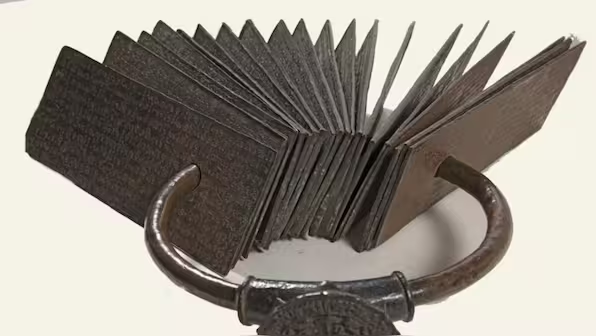
The return of the Chola copper plates calls for a greater and deeper rejoicing. Its recovery connects us to a dynamic and powerful past, which can propel our future quests. (Image: Wikimedia Commons)
Just as the return of the sacred Piprahwa Gem Relics, after 127 years, to India was an epochal step forward in the recovery of India’s civilisational legacy and heritage, the return of the Chola era, Anaimangalam Copper Plates, also known as the Leiden Copper Plates, firms up India’s aspirations to rise as a civilisational state. Narendra Modi has been relentless in his pursuit of recovering India’s civilisational symbols and footprints. What once belonged to India, must come back to India.
A civilisation, after long subjection, aspires to recover its essential self. That recovery is expressed through development, through developing and adapting new technology, generating new thought, and absorbing and examining new ideas and knowledge from across the world, through recovering its knowledge systems and its heritage and symbols.
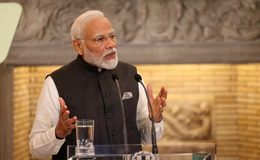
The Piprahwa Gem Relics, intrinsically connected to Buddha’s life, and the Anaimangalam Copper Plates, which express the breadth and length of civilisational India during the Chola era, fall in the category of defining civilisational symbols. After centuries the Anaimangalam plates were restored to India during Prime Minister Narendra Modi’s visit to the Netherlands on May 16. Many have missed the deeper symbolism behind this recovery. Others, having realised it, have only tried to muddy the waters politically.
The Anaimangalam plates signify the global and civilisational outlook that India possessed a thousand years ago. It indicates the sophisticated and refined administrative and state system that was in place in the Chola era. It also records India’s civilisational reach and spread. The plates record the permanent land and revenue grant of the Anaimangalam village near Nagapattinam for the upkeep of the Buddhist Vihara, Chudamani Vihara, built by the ruler of Srivijaya, Sri Mara Vijayottungavarman, with permission from the mighty Chola king, Rajaraja Chola. Rajaraja had issued the order verbally, and his son, the iconic Rajendra Chola, had the order formally engraved on copper plates so that the grant would have permanent legal and royal authority.
The plates demonstrate the meticulous record-keeping and documentation that the Chola administration followed and the intricate administrative system that had evolved under its rulers. The plates also signify another fundamental point. It records how one of civilisational India’s greatest Hindu monarchs upheld the request to build a Buddhist Vihara and permanently ensured its upkeep. It shows the Hindu-Buddhist confluence and synergy in civilisational India. Rajendra Chola can be described as the first global Indian monarch. The Cholas, who were intense worshippers of Shiva, were also patrons and benefactors of Buddhism.
One of the most perceptive historians of India’s connection with Southeast Asia, RC Majumdar, writes in his seminal work “Hindu Colonies of the Far East” that Chola inscriptions record how around the 21st year of Rajaraja Chola’s reign, at the start of the 11th century, the king of the Sailendra empire, present-day Sumatra, Chudamanivarman, “commenced the construction of a Buddhist Vihara at Nagapattana, modern Negapatam” when a village was granted by the Chola king for its upkeep. King Chudamanivarman “died shortly after, and the Vihara was completed by his son and successor, Sri-Maravijayottungavarman”.
In the course of his research and writing, Majumdar had visited Europe several times. In Europe he had undertaken archival research in several institutions and universities, including the Kern Institute at Leiden University, which had a rich repository of records on India’s transactions and links with Southeast Asia. Majumdar seemed to have clearly based his record on the Anaimangalam copper plates which he must have accessed at the Kern Institute.
In his famous memoirs in Bengali, “Jibaner Smritidipe” (In the Memory-Island of Life), Majumdar writes of how he first visited Europe in 1928 and spent a few months doing research in Leiden, at the Kern Institute. The Kern Institute in Leiden, writes Majumdar, is a famous institution and contains a lot of material which was needed and relevant to my research. Majumdar was acquainted with the founder of the Kern Institute, the Dutch epigraphist and Sanskritist J Ph Vogel, who had also worked in the Archaeological Survey of India. Answering his request Vogel invited Majumdar to visit the Kern Institute and arranged for him to stay with a Dutch family during his research sojourn. At the Kern Institute, recalls Majumdar, he took plenty of notes on his research topics.
The Chola plates contain both Tamil and Sanskrit portions, signifying rootedness in the Tamil identity and connectedness to the larger Bharatiya essence. No false dichotomies existed then. It counters narrow political narratives of Tamil history, which insist on antagonism between Tamil and Sanskrit. It signifies an India, culturally rooted and confident, administratively sophisticated and advanced, with global footprints and connections. The Chola age was an era when India wielded enormous maritime power; the return of the Anaimangalam plates brings to the fore and establishes that powerful and vibrant past.
Time and again, PM Modi has displayed an undiluted doggedness in his pursuit of India’s civilisational symbols. The Leiden plates’ repatriation is the result of a prolonged diplomatic and institutional engagement driven by an unswerving political will. It is also part of the larger mission of the Modi era for recovering that which is rightly India’s.
Countries such as the United States, Australia, the United Kingdom, Singapore and the Netherlands have returned Indian antiquities in large numbers in recent years. Some of the major returns were the Chola bronzes, Nataraja idols, sculptures, and manuscripts from these countries. They indicate a sustained effort for a civilisational recovery. The Anaimangalam plates recovery symbolises a convergence of Tamil pride, national pride and the success of PM Modi’s indefatigable civilisational diplomacy led by a deeper conviction of the strategic uses of soft power.
The apathy of past eras driven by the Congress mindset has dissolved. Records reveal that between 1974 and 2024, 655 antiquities were recovered from foreign countries, out of which 642 have been recovered since 2014. This also means that only 13 antiquities had returned to India till 2014.
PM Modi has completely altered that approach. For him, it is not just recovering objects; it is recovering India’s civilisational sense and memory. The return of the Chola copper plates calls for a greater and deeper rejoicing. Its recovery connects us to a dynamic and powerful past, which can propel our future quests.