Built and rebuilt, Somnath echoes India’s eternal civilisational resolve
- By : Anirban Ganguly
- Category : Articles
India’s resurgence, has to be driven by a deeper spirit of resilience and by a lasting commitment to preserving and rejuvenating her cultural symbols
Somnath – the ‘Shrine Eternal’, as one of its foremost chroniclers, KM Munshi, has described it, symbolises civilisational resilience and resurgence. Munshi, who played one of the most pivotal roles in its resurrection in free India, was also one of the finest exponents of Somnath’s civilisational significance and power.
Of Somnath’s civilisational significance and of its symbol of resilience and resurgence, Munshi movingly writes, “Somanatha was the shrine beloved of India. In its worship she found ancient glory, and unending inspiration. In maintaining it with magnificence, she felt a throbbing zeal to maintain the core of her faith, tradition and collective greatness. An ancient race subconsciously felt that it was Somanatha which connected it with the past and the present; it was the eternal symbol of its faith in itself and its future. As often the shrine was destroyed, the urge to restore it sprang up more vividly in its heart.”
Interestingly, Munshi’s epic novel Jaya Somnath, which, while chronicling the 11th-century destruction of Somnath at the hands of Mahmud Ghazni, popularised in the public mind the demand for its restoration, was “written in Pahalgam in Kashmir” with the waters of the Sheshnag lake “dancing from stone to stone with endless exuberance in front of him”. That symbolic link ought not to be lost.
By drawing our attention to the significance of Somnath, Prime Minister Narendra Modi has emphasised it as that “eternal symbol” of our faith in ourselves and in our future as a civilisation. Somnath’s cycle of destruction and restoration had left a deep impression on a “parivrajak”, Vivekananda. Referring to his sight of the ruins of Somnath, years later in Madras, Vivekananda spoke on how it bore the marks of “a hundred attacks and a hundred regenerations, continually destroyed and continually springing up out of the ruins, rejuvenated and strong as ever”. For Swami Vivekananda, it signified the “national mind” and the “national life-current”.
Sardar Patel, whose firm and prescient vision and leadership initiated the reconstruction saga of Somnath in free India, also perceived this deeper civilisational significance of Somnath. On Sardar’s uncanny understanding of this significance, of the national urge for Somnath’s reconstruction, Munshi writes that the Sardar saw “that we would never genuinely feel that freedom had come, nor develop faith in our future, unless Somanatha was restored”.
Sardar was in a hurry to get the reconstruction started, since he had perceived its centrality in independent India. In a letter to “Kanubhai”, KM Munshi, on February 27, 1950, Sardar wrote, “I have received the photographs [of the architectural designs and plan of the Somnath temple] that you have sent me. I shall arrange to send donations for the Somnath Trust to its Secretary. But the work must go on in full speed…”
In his unique quest to embed in the national psyche the vision and significance of “Vikaas” (development) and “Viraasat” (civilisational legacy and heritage), PM Modi has drawn our collective attention to a crucial and defining phase in 2026. It is a phase, a commemoration, which is intrinsically linked to the aspiration of decolonisation and civilisational resurgence.
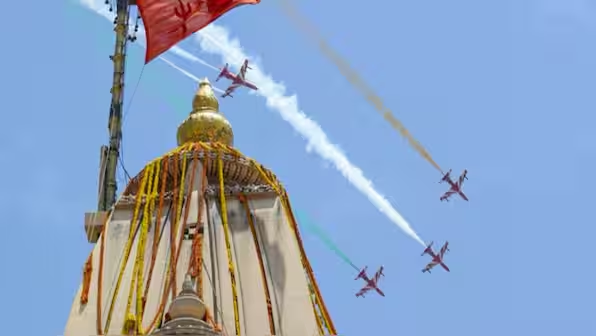
PM Modi reminded us at the start of 2026 that the year marked “a thousand years since the first attack on the Somnath Temple”. On May 8, 2026, he reminded us that this year also marks the 75th anniversary of the “inauguration of the restored Temple by the then President of India, Dr Rajendra Prasad”. It is in this saga of destruction and resurgence that can be found the strength and inspiration for India’s civilisational resurgence.
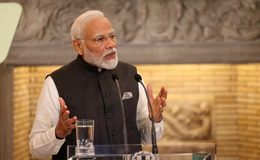
In his address from Somnath, on May 11, PM Modi inspiringly spoke of how the Somnath temple radiated free India’s consciousness, of how it symbolised the will to recreate even in destruction and exuded India’s unending spiritual consciousness for over 1000 years. Few would have missed the significance of these dates. Especially for those who see the resurgence of India as a civilisational state, Somnath stands as a symbol of that aspiration.
Unfortunately, in free India, the Nehruvian system, for a long time, denigrated faith and ignored and neglected our civilisational and dharmic centres and symbols. KM Munshi’s famous repartee to Nehru on Somnath, when the latter stigmatised the sacred effort as a communal project; Rajendra Babu standing up to Nehru; and attending the “prana-pratistha” of Somnath are all well-recorded in history. Nehru denigrated Somnath’s consecration as a “pompous ceremony” and repeatedly wrote on how “worried” he was and on how it would “injure us abroad and even in India”.
To RR Diwakar, then Union Minister for Information and Broadcasting, Nehru wrote, “Our radio broadcast should rather tone down the description of what happens at Somnath and not make it appear in any way that it is a governmental function.”
To Mridula Sarabhai, Nehru complained in April 1952 about how “this business of the Somnath temple” was giving him much trouble. To Jam Saheb Digvijaysinghji, who was a key figure in the reconstruction of Somnath and who had formally written to Nehru, inviting him for the ceremony, Nehru resorted to his tired argument: “I am troubled by this revivalism and by the fact that our President and some Ministers and you as Rajpramukh are associated with it. I think that this is not in line with the nature of our State and it will have bad consequences both nationally and internationally.” On April 22, Nehru again wrote to the Jam Saheb, his main argument being that “so far as the Government of India is concerned, I am going to make it perfectly clear in answer to questions in Parliament that they have nothing to do with this matter”.
Nehru repeatedly attempted to dissuade Rajendra Prasad; he was possessed in his opposition to Somnath and markedly disassociated himself and his government from it. To Rajen Babu, he wrote on March 2, 1951, “I confess that I do not like the idea of your associating yourself with a spectacular opening of the Somnath temple. This is not merely visiting a temple, which can certainly be done by you or anyone else, but rather participating in a significant function which unfortunately has a number of implications.”
Though the Somnath Trust and its Somnath reconstruction work were supported by donations made by the public and in no way utilised public governmental funds, Nehru kept harping on that false point and doubted almost everyone. This technical anxiety of his essentially masked a deeper malaise.
Nehru never believed in a civilisational resurgence; he was wary of India’s civilisational symbols and centres acquiring a new life and significance in free India. His secular India stood on the denigration of Sanatani traditions and symbols. The reconstruction of Somnath and its deeper symbolism was anathema to him. He wished to create an artificial state apparatus, devoid of a civilisational sense and energy. In his scheme of things, Vikaas had to happen, minus Viraasat. His vision of India, as a global player, was only a theoretical proposition. That aspiration did not stand on development, strength and civilisational heritage. Even after the Somnath temple was reconstructed, the Nehruvian system did everything it could to suppress and minimise its legacy and significance. It marginalised that historic effort in our national march.
PM Modi has halted that marginalisation, that denigration. India’s civilisational rise, her resurgence, has to be driven by a deeper spirit of resilience and by a lasting commitment to preserving and rejuvenating her cultural and religious symbols. The deeper significance of his Somnath commemoration lies in that essential truth.