Balakrishnan writes that the communists knew very well that ‘helping the British government directly would be counter-productive. So, the direct means of anti-Japanese resistance was adopted instead. Since the “Japanese were not available in India for offering resistance, Subhas Chandra Bose” and his followers and admirers were victimised. Their “attack against Subhas Bose was particularly virulent.”
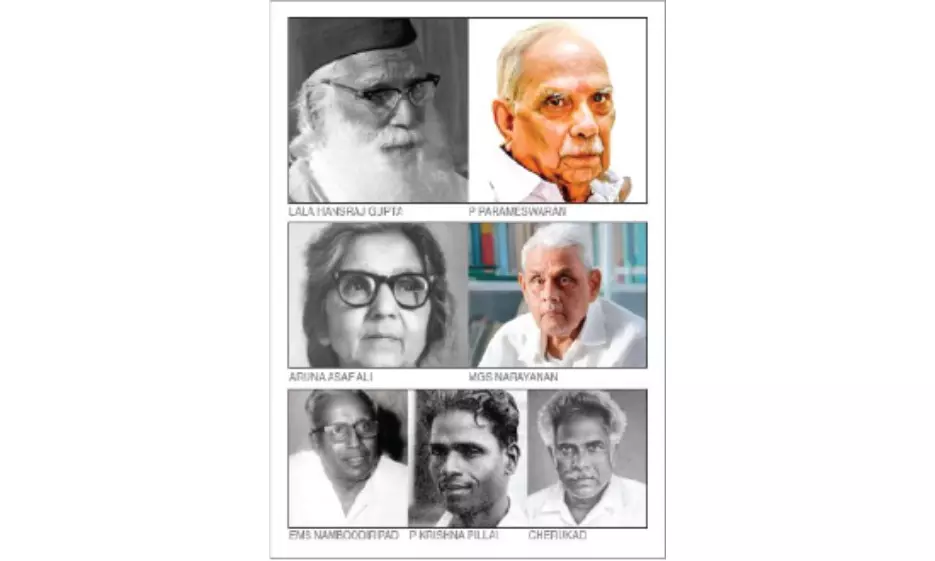
Balakrishnan also records P Krishna Pillai, one of the founding members of the CPI, then secretary of the CPI’s Kerala Committee, for instance, writing in the Deshabhimani, on 4 October 1942, spoke of Subhas Bose as a “base fellow” who has “sold himself to the Japanese”, a “most detestable traitor trying to enslave this country to the Japanese.”
Veteran historian MGS Narayanan (1932-1925) writes in his introduction to Balakrishnan’s work that communist leaders like EMS Namboodiripad (1909-1998), “specialised” in the “art of pseudo-psychological theorising while supporting diametrically opposite positions.” Without batting an eyelid, they “used the dirtiest slang words against Mahatma Gandhi and Subhas Chandra Bose, and the leaders of the Congress in Kerala like K Kelappan (1889-1971) in the party’s propaganda literature.”
P Parameswaran (1927-2020), thought-leader, RSS Pracharak and a prolific author from Kerala, writes how communists “claiming to follow Gandhiji,” denounced “him in the most uncharitable terms” and “while eulogising revolution, they betrayed the greatest revolutionary, Netaji Subhas Chandra Bose and showered him with the choicest abuses without decency or decorum.”
Despite his erudition and propensity to break traditions, EMS Namboodiripad had a peculiar weakness for Islamists. In 1993, for instance, while campaigning for the by-election to the Ottapalam Lok Sabha constituency (Alathur Lok Sabha constituency since 2009), EMS had equated radical Islamist Abdul Nasser Madhani to Mahatma Gandhi, arguing that Madhani was using Islam for a noble societal cause just like the Mahatma, who spoke of “Ram Rajya” for liberating India. This was classic EMS in his “pseudo-psychological theorising mode”, pandering to the worst kind of communal mindset. In 1998, Madhani was found to have been involved in the Coimbatore serial blasts and the 2008 Bangalore serial blasts.
In fact, argues MGS, “the communists of Kerala were busy building up their power base with the help of the British in the immediate pre-independence period since 1942, and they made a serious bid to sabotage the advent of freedom in the period from 1946 to 1948 by promoting sporadic acts of terrorism in North Malabar and Travancore. When they failed in this attempt, they were prepared to make a successful bid for power through elections by joining hands with the separatist communal forces like the Muslim League…”
Balakrishnan tells us that by August 1946, the militancy of the communists became “violent, cruel and inhuman” and the “inherent inhumanity of communist bellicosity during August 1946 was seen in the attitude shown to communal riots.” Communists had been “cooperating with the Muslim League and had been supporting the League demand for Pakistan”, and in that connection, the communists in Kerala, like their colleagues in other parts of the country, “decided to cooperate with the League in the observance” of the Muslim League’s Direct Action Day on 16 August 1946. In Malabar, communists “did everything to incite Moplahs for an open revolt” with EMS writing “leaflets inciting” them to revolt.
In 1942, RSS Swayamsevaks, scattered across India, were working, both covertly and overtly, in trying to carry forward the Quit India momentum. That episode and aspect require a separate look. One example would suffice for the present discussion. Ranga Hari, one of those rare authorities on the history and evolution of RSS, in his biography of Sri Guruji, reminds us of Aruna Asaf Ali’s (1909-1996) (née Ganguly) reminiscences of 1942, when she was underground evading the British police.
In an interview she gave to the Hindi daily Hindusthan in 1967, Aruna Asaf Ali recalled how educationist, social leader and RSS Prant Sanghchaalak of Delhi, Lala Hansraj, had sheltered the young Aruna in Delhi, in his house for 10-15 days. “I was underground in 1942 agitation. Delhi Sanghchaalak Lala Hansraj provided me refuge in his house for 10-15 days and arranged for my complete safety. He saw to it that nobody got information about my stay at his house…” The bold Aruna had hoisted the Congress flag at the midnight meet in Mumbai on 9 August 1942, when Mahatma Gandhi announced the Quit India movement. She went underground, successfully evading arrest till 1946, when she resurfaced. Countless Swayamsevaks supported the Quit India call in a thousand ways, while communists exerted themselves over time to foil the movement.
After 11 years of Narendra Modi and 12 consecutive Independence Day addresses by the PM, communists and their megaphones have been compelled to at least start pretending that India’s Independence Day and not the “Long March” or “May Day” is an occasion that they need to recognise, observe and try to follow, if not commemorate.