Messenger of the Dhamma
- By : Anirban Ganguly
- Category : Articles
Beyond politics, Dr Mookerjee emerged as independent India’s foremost ambassador of Buddhism, reconnecting ancient civilisational bonds across Asia through culture
As we commemorate the 125th birth anniversary of Dr Syama Prasad Mookerjee and discuss and celebrate his multifaceted life and contributions there is one dimension of his life which makes him stand apart from many others of his era and generation. As the messenger and ambassador of Buddha and Buddhism, Syama Prasad attracts our attention. A unique blend, perhaps in that epoch, a rarity in our times.
Just as he never severed his connection and link with education, Syama Prasad, the president of the Hindu Mahasabha, member of the Constituent Assembly, the creator of West Bengal, free India’s first industry minister, the founder president of Bharatiya Jana Sangh, member of the first Lok Sabha, the undeclared Leader of Opposition, the valiant defender of India’s unity and integrity, grew into becoming one of India’s finest cultural and civilizational ambassador in the early years after independence. He had a lifelong interest in and connection with India’s Buddhist legacy and heritage.
On becoming president of the Maha Bodhi Society of India, Syama Prasad emerged as one of the finest spokespersons and representatives of civilizational India’s Buddhist legacy and inheritance. Between 1942 and 1953, while being seen, accepted and followed as one of modern India’s most towering Hindu leaders, Syama Prasad was also recognised as one of the most energetic ambassadors of Buddha and of Buddhism, from the land of its origin. There was no contradiction in his persona and psyche between his Hindu persona and his championing of India’s Buddhist legacy.
D Valisinha, general secretary of the Maha Bodhi Society during Syama Prasad’s tenure, writes that he was “elected unanimously with universal approbation” and that he “proved to be the most energetic, resourceful and hardworking President we ever had…”
The Maha Bodhi Society of India, in those days, was a nodal institution and movement and the presidentship of that body came with a role and responsibility that resonated across the Buddhist world.
By the time he became president of the Maha Bodhi Society, Syama Prasad had already made a deep impression in the political and educational firmament of India. He had earned wide recognition for his erudition, sagacity and for his pragmatist nationalist approach and politics. His father, Asutosh Mookerjee, before him, had contributed immensely to rekindling study and research in India’s Buddhist heritage and legacy. Asutosh initiated the Pali department in the Calcutta University in the early 1900s and, as Vice Chancellor, encouraged and patronised scholars in the study and research of civilizational India’s Buddhist heritage.
Asutosh Mookerjee was invited to become president of the Maha Bodhi Society and, in his lifetime, among other things, became one of India’s most visible symbols of her rekindled interest in her Buddhist legacy. For his contribution to Buddhism in modern times, writes Dinesh Chandra Sen, legendary litterateur and scholar of Bengali language and literature, Asutosh Mookerjee was conferred the title of “Sambuddhagama Chakarvarty”, the one great soul who treads the path of the Buddha, by the Buddhist sangha of Sri Lanka, more specifically by the influential and then dominant Amarapura Nikaya.
A lot of that activism and work had flowed into Syama Prasad. While doing his Master’s in Bengali language and literature, Syama Prasad and opted for a paper on Sinhalese language. Fascinated by languages, he understood early that they could act as active civilizational bridges.
Later as the youngest Vice Chancellor of the Calcutta University, Syama Prasad encouraged and supported Buddhist studies and promoted the study of Pali. It is symbolic that Syama Prasad Mookerjee’s finest political and most accomplished political heir, his manasputra, Narendra Modi, declared Pali as a classical language, conferring on it the exalted status of a living civilizational heritage of India.
In his activism and outreach through and for India’s Buddhist legacy, Modi comes across as fulfilling and amplifying Syama Prasad’s aspirations. As Syama Prasad, Modi too blends his political and statesman persona with his active interest and dynamic drive in disseminating India’s Buddhist legacy. He deeply understands, just as Syama Prasad did in his time, the unique strength and power of India’s Buddhist legacy in reforging civilizational partnerships and bonds.
Eminent historian Niharranjay Ray, one of India’s greatest Buddhist scholars, Beni Madhav Barua, who taught Buddhist studies and Pali in Calcutta University, have spoken of Syama Prasad’s munificent support in their studies and research on Buddhism.
Syama Prasad saw through and presided over several historic events that symbolized a free India aspiring to recover her civilizational and cultural legacy. It was at Syama Prasad’s behest and active interest that the sacred Relics of Buddha’s two chief disciples, Mahamogallana and Sariputta were repatriated to India from the Victoria and Albert Museum in London in January 1949, after 100 years. The mind is naturally drawn to our times, when at the behest and intervention of PM Modi, the sacred Piprahwa Gem Relics, about to be auctioned in a foreign land to a foreign entity, were repatriated to India after 127 years.
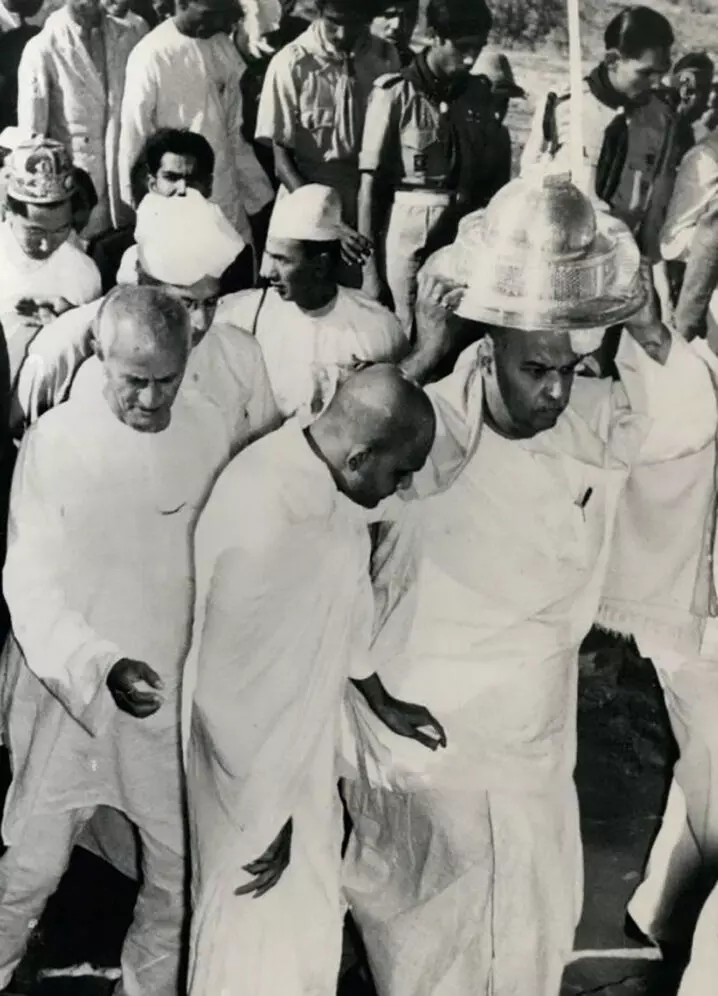
It was at Syama Prasad Mookerjee’s initiative that the Relics of Mahamogallana and Sariputta were enshrined at the Chetiyagiri Vihara in Sanchi, which was inaugurated, through a grand ceremony in November 1952, next to the iconic Sanchi Stupa. Over 50,000 people attended that deeply symbolic event, which signified a new cultural awakening in free India.
As president of the Maha Bodhi Society, Syama Prasad conceived and organised the first-ever International Buddhist Cultural Conference (IBCC) in India in Sanchi in November-December 1952. It was to be his last major public event. The IBCC was held under the presidentship of Dr S Radhakrishnan, then Vice President of India, over 2000 delegates participated in it, including distinguished visitors, scholars and monks from various parts of the world.
Pandit Nehru, Prime Minister of Burma, U Nu, Home Minister of Sri Lanka A Ratnayake, Venerable Kushak Bakula Rinpoche of Ladakh, Acharya Narendra Deva, then Vice Chancellor of Banaras Hindu University, historian Radha Kumud Mookerjee, Bhikkhu Jagadish Kashyap, among a host of others, were present. Ambassadors and representatives of Buddhist countries participated in the IBCC. It was the first such Buddhist mega event in independent India.
Dr Mookerjee’s role as India’s unofficial cultural ambassador received international recognition. He led “Dhamma Yatras”, with Relics of Arhants Mahamogallana and Sariputta, to Southeast Asian countries such as Burma, Cambodia, Thailand and Vietnam. Addressing massive crowds in these countries, Dr Mookerjee spoke of Buddha’s message and of India’s cultural and spiritual link with these countries.
In October 1952, Dr Mookerjee visited Cambodia, with the sacred Relics, at the invitation of King Norodom Sihanouk and the Government of Cambodia. A sea of humanity awaited him, as the flight from Bangkok hovered over and landed in Phnom Penh. Over a million people lined up the route from the airport to the city. Dr Mookerjee addressed over half a million people in the city’s main square on Lord Buddha’s message and the cultural ties that bound India and Buddhist countries.
When he led the delegation to Myanmar, with the Relics, and later ensured that a portion of it was given as a permanent loan from the people and Government of India to the people of Myanmar, an effusive Prime Minister U Nu, himself a distinguished Buddhist scholar, told Dr Mookerjee, “You do not know how great a service you rendered to my country…Your visit with the Relics brought about a wonderful change in my people. They have found their soul.”
Today, when PM Modi has led the resumption of these “Relics Dhamma Yatras” across the world, the mind flies back to that era when Syama Prasad resumed these yatras, after a millennium-long hiatus, in free India. Millions of people, having a glimpse of the sacred Relics from Thailand to Vietnam, from Cambodia to Mongolia, from Ladakh to Sri Lanka, today, display an earnest aspiration to revivify and rekindle the special civilizational bond between India and these countries and civilisations, also nurtured and shaped by Lord Buddha’s message.
One of Dr Syama Prasad Mookerjee’s last communications, in April 1953, a few weeks before his 45-day detention in Kashmir that led to his death, was to the Prime Minister of Sri Lanka, D Senanayake, expressing his hope to lead a delegation with the Sanchi Relics to Lanka in the winter of 1953. That was to never be.
As we celebrate his many lives and legacy, let us also recall and commemorate Syama Prasad Mookerjee, as Bhagavan Buddha’s ambassador, as one of free India’s earliest and most radiant cultural and civilizational messengers.
Source: https://www.millenniumpost.in/opinion/courage-to-speak-the-truth-667250