Narendra Modi accords Netaji Subhas Chandra Bose’s legacy its rightful place as cynics sulk
- By : Anirban Ganguly
- Category : Articles
For decades after Independence, Netaji’s legacy was paid perfunctory and ritual homage by successive Congress governments, whose leaders worked all the time, to dilute and to marginalise his unmatched contribution to the freedom movement.
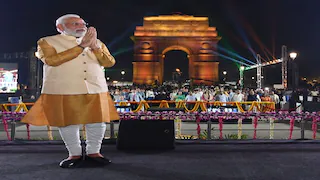
This year, 8 September, will go down as a golden day in India’s celebration of the 75th year of her Swaraj. Besides renaming “Raj Path” – Kingsway – in the heart of India’s national capital as “Kartavya Path” – the Path of Duty – Prime Minister Narendra Modi, did what no other Prime Minister of India had the temerity or conscience to do. He unveiled, having commissioned it only a year ago, a grand 28 feet statue of Netaji Subhas Chandra Bose, iconic fighter and leader of India’s freedom movement. That such a thing would or could happen one day, was beyond the realm of belief.
A wish nurtured for decades and by generations, post-independence, that of seeing Netaji stand tall at India Gate in a free India, had almost been abandoned and shelved when Prime Minister Modi undertook, in 2018, a very systematic effort to reinstate Netaji’s legacy and to offer him a nation’s gratitude. In fact, the autumn – Sarat Kāla – of 2022, India and especially West Bengal has much to rejoice. For the first time Durga Puja shall be celebrated post the conferring of the UNESCO tag for intangible heritage and for the first time in independent India’s history, Netaji Subhas Chandra Bose’s statue shall stand henceforth sentinel over India’s destiny at the junction of Kartavya Path, National War Memorial and India Gate, in the historic heart of India’s capital.
Both these deeply symbolic and significant achievements reached fruition only because of Prime Minister Modi’s insistent action towards ensuring that a comprehensive cultural recovery and decolonisation, in terms of symbols – both cultural and historic – occur, so that the consciousness of freedom and the aspiration to consolidate that freedom and to use it to spring towards a civilisational status can be achieved and realised. One of the essential actions of “Amrit Kaal”, must necessarily be the eradication of old symbols which remind us of subjection, of our past ambivalence and timidity and reinstall and re-kindle in their place, symbols and centres that indicate, instil and radiate a sense of civilisational rise.
To those overcome with emotion, the unveiling of Netaji’s statue was a moment which finally fulfilled his epic call of “Delhi Chalo” – Onward to Delhi, which was a rallying cry for the Indian National Army (INA). In fact, in his historic address on the occasion of the unveiling, Prime Minister Modi poignantly recalled, Netaji’s thoughts when he first set foot on the first bit of Indian soil that is Andaman and Nicobar in December 1943 and hoisted the “Tri-colour” – an epic event whose 75th anniversary he celebrated by leading from the front in 2018.
In a broadcast from Rangoon – Yangon – on 9th July 1944, Netaji movingly described that thrill and his hope, “During the visit [to Andaman & Nicobar Islands in December 1943] I and the members of my party had the unique experience of our lives when we stood on the soil of free India for the first time. It was an unforgettable event for us to see our tri-colour national flag fluttering in the air over the former British Chief Commissioner’s residence in Ross Island. During our stay there we occupied the former British Chief Commissioner’s residence, and we wondered all the time how the wheels of victory were now moving in India’s favour. The sight of our national flag flying over the Chief Commissioner’s house made us all think of the day when the same flag will be hoisted over the Viceroy’s House in New Delhi.”