Modi and the New Global Symmetry
- By : Anirban Ganguly
- Category : Articles
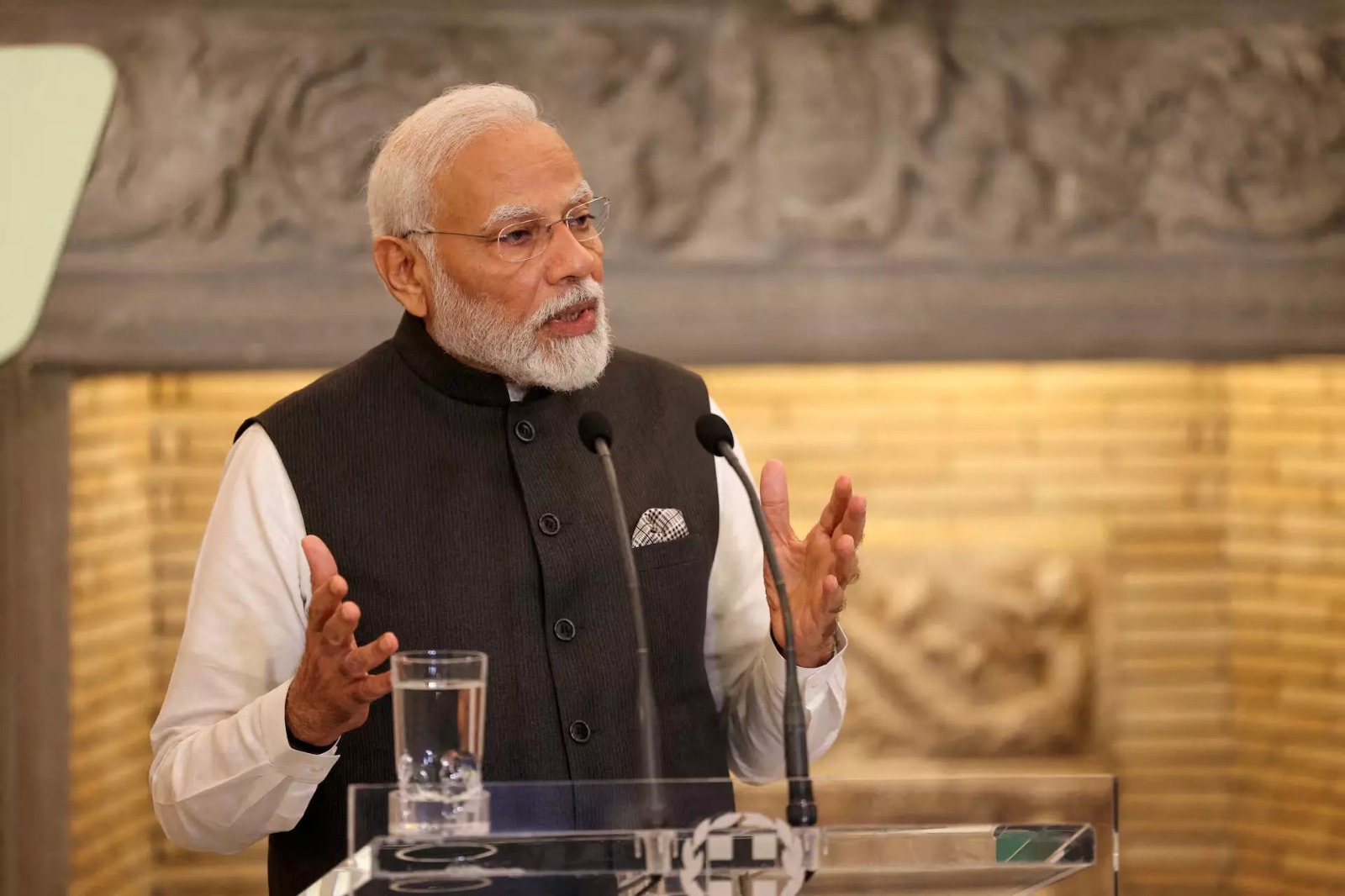
PM Modi’s push for reformed institutions and equitable partnerships has increasingly echoed through the evolving Global South discourse
As Prime Minister Narendra Modi completes 25 years in public office and, in that, 12 years as Prime Minister of India, his vision for a new and reformed global order has clearly generated debate across the world. Modi has emerged as the philosopher and shaper of the Global South narrative.
Modi’s governance philosophy and method have repeatedly attracted global attention, and his solution-oriented approach has received international endorsement.
When President Subianto of Indonesia spoke of replicating Modi’s governance models successfully in Indonesia, it indicated the impact Modi’s methods were having globally, especially in countries with which we have a civilisational likeness.
Nearly a decade ago, veteran Singaporean diplomat and public intellectual Kishore Mahbubani had spoken of Modi’s conviction that good governance could transform and uplift society. That recognition has spread in the intervening years, making Modi one of the most consistent upholders of global good through good governance.
Modi’s approach has been to prod the Global South to partner and collaborate in evolving best practices in governance. This was reflected in BRICS Delhi, when Modi spoke of “Capacity Building for Developing Nations.”
Recognition for Modi is not limited to his governance. In international diplomacy, to the chagrin of Modi’s domestic and international detractors, he is being recognised as a solution seeker, a voice of stability and an advocate for the narrative of shared prosperity.
President Putin’s remarks at the latest edition of the Valdai Discussion Club, candidly appreciating PM Modi’s strong intent in finding a peaceful and mutually acceptable solution to the Ukraine-Russia conflict, are one of the finest and most direct recognitions of Modi’s international standing.
Modi’s call for reformed international institutions is increasingly finding takers. His call to dismantle the “Pyramid of Privilege” in global institutions and alter it to an inclusive “Platform of Partnership” reiterates that. Modi does not speak of a triangular contest between a Global West, Global East and Global South. He is driven by a legitimate quest for equity in global governance and decision-making.
In his Foreign Affairs essay, “The West’s Last Chance: How to Build a New Global Order Before It’s Too Late”, Finnish President Alexander Stubb argues that the Global South will play a defining role in deciding “whether geopolitics in the next era leans towards cooperation, fragmentation or domination.” Stubb argues that this is the last chance for Western countries to convince the rest of the world that they are capable of dialogue rather than monologue, consistency rather than double standards, and cooperation rather than domination.
International institutions, Stubb says, “need to be updated and reformed to better reflect the growing economic and political power of the Global South and Global East.” He insists that Western leaders must now act to get it done, and it has to start by “rebalancing the power within the UN” and other international bodies such as the IMF, WTO and the WB.
Without such changes, Stubb sees the existing multilateral system “crumble.” He speaks of a “new symmetry of power among the Global West, East, South” that would “produce a rebalanced world order in which countries could deal with the most pressing global challenges through cooperation and dialogue among equals.” Stubb’s position reflects and echoes Modi’s aspirations for the Global South.
Kishore Mahbubani, in his essay “The Dream Palace of the West: Why the Old Order is Gone for Good”, in the same journal, starkly endorses the Global South. “Engaging with the Global South,” writes Mahbubani, “is not just an exercise in listening. It also requires Western governments to reassess their own positions and approaches to a world they have long taken for granted.” Mahbubani calls for reformed multilateral institutions “to accommodate rising powers, especially India and China” and calls for an enlarged UNSC with India, among others, as a permanent member.
Mahbubani calls for dialogue among equals. “A good dialogue,” he argues, “requires good listening. Unfortunately, the 12 per cent of the world’s population that lives in the West hasn’t yet learned the art of listening to the remaining 88 per cent with whom they share the planet.” When Modi calls for dismantling the “Pyramid of Privilege” and creating an inclusive “Platform of Partnership”, he is essentially asking that 12 per cent to listen, to have a good dialogue and to evolve a partnership of equals with the remaining 88 per cent.
Modi is not proposing a contest. He is delineating, instead, a roadmap, an alternative order that is more inclusive and responsive. Unlike his predecessors from the past, PM Modi does not want to keep India out of this debate. He wants India to be an active stakeholder and shaper of the new order. He wants India to help rebalance and establish a new symmetry. In the last 12 years, he has forced an increasingly dynamic and multidimensional global debate on the future of the world.