The Indo-Pacific: A civilisational idea of India
- By : Anirban Ganguly
- Category : Articles
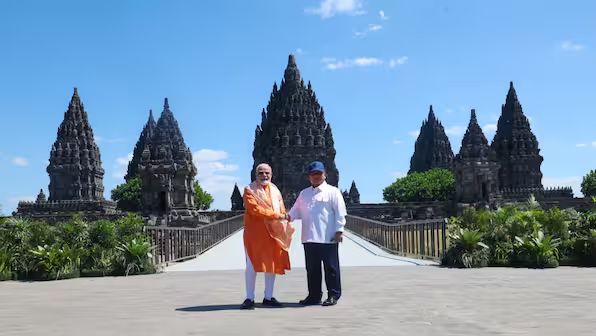
Prime Minister Narendra Modi and President Prabowo Subianto inaugurate the UNESCO World Heritage Prambanan Temple Compound Restoration and Conservation Project in Indonesia on Wednesday. Image Courtesy: @narendramodi
The Indo-Pacific is an Indian civilisational construct. For over a millennium, civilisational India’s maritime, commercial, cultural and philosophical exchanges and contacts with the civilisations, settlements and peoples of the Pacific region incubated and nurtured these bonds. Prime Minister Narendra Modi’s tour of the Pacific space reiterates that perspective and seeks to reimagine the contours of the Indo-Pacific from a civilisational perspective.
Prolific cultural philosopher, author and historian Kalidas Nag was perhaps the first Indian to refer to the “Indo-Pacific Domain” in the modern context. Working on India’s civilisational footprints in Southeast Asia and the Pacific region since the 1920s, Nag, a close collaborator and disciple of Gurudev Rabindranath Tagore, had accompanied the Poet to the Far East in 1924.
Tagore visited Southeast Asia in 1927. His visit to Indonesia — Java, Sumatra and Bali — was a turning point in modern India’s outreach to her past civilisational partners. Tagore spoke of India’s history running “through the history of the civilisation of Eastern Asia”. He likened the “civilisation of India” to a “banyan tree” that has “spread its beneficent shade away from its own birthplace…”. He was perhaps the greatest Indian and Bengali since the legendary Bengali Buddhist monk-teacher Atisa Dipankara, who, it is said, had visited Sumatra in the 10th century and had stayed on for a decade in the “Suvarnadvipa”.
Polyglot and polymath Suniti Kumar Chattopadhyay, who had accompanied Tagore during his Southeast Asian tour in 1927, has left behind a detailed and exquisite description of his Indonesian tour. Written in Bengali, Chattopadhyay’s Dwipamay Bharat (“Island-India”) remains a classic on Tagore’s visit to the region and on India’s civilisational ties with Southeast Asia, especially Indonesia.
In his tract Java O Balir Nrityageet, the legendary exponent of Tagore’s music, dance and poems, Santidev Ghosh (1910-1999), who spent a lifetime at Santiniketan, writes that Tagore’s visit to Indonesia renewed that age-old link in our age. It awakened interest in the art and art forms of Indonesia among the intelligentsia of Bengal and of India, and attraction towards India was also rekindled amongst the educated in Indonesia.
An Indonesian cultural teacher — Siksha Guru — named Devantar would regularly send students to Santiniketan. In 1939, Tagore arranged for Santidev to visit Indonesia to undertake training in dance and music. Santidev visited Java, Bali and Denpasar, and his descriptions of that visit are still fascinating to read.
Of Tagore’s visit to Indonesia, Kalidas Nag writes in the centenary tribute volume on the Poet that Tagore arrived in an Indonesia that was “changing slowly but surely”. The Poet, records Nag, “actually met (without knowing or forecasting his future) Mr Soekarno, the youthful leader who would lead the Indonesians to freedom from the 300 years of colonial rule of Holland.”
After this historic visit, “students from Java and Bali began to visit Santiniketan, which, thanks to the Poet’s vision, offered the best seat for Southeast Asia studies”. Iconic painters such as Surendranath Kar and Dhirendra Krishna Dev Burman, who had accompanied Tagore on that trip, “introduced into Indian art several traits of Indonesian arts and crafts, including Batik and mask designs”.
Tagore himself was the greatest creator of this India-Indonesian cultural and artistic fusion. “Above all,” writes Nag, “the Poet-artist with his creative genius, fused Indonesian dance patterns into his own dance-dramas mainly composed after his visit to Java and Bali… To the Poet was opened a new horizon of art creation in dance and décor, on his way back from Bali to the heart of Javanese art revival – Surakarta and Jogyakarta.”
For Nag, the “whole of Indonesia” deserved to “be studied with the utmost care and thoroughness by Indologists in general and by Indian scholars in particular”, since the “living traditions of their arts and crafts, when studied from within, will help undoubtedly to foster the artistic life of India”.
The special fusion and expression of India and Indonesia seen in history struck Kalidas Nag. He writes of how everywhere one noticed “the simultaneous existence of Brahmanical and Buddhistic cults, often tending to fuse into one another, producing peculiar images of Vishnu, Garuda, Ganesa, Siva”. Saivite and Buddhist images were found in Borneo, while images of Mahadeva, Kartikeya, Ganesa, Vajrapani and other Bodhisattvas were common.
PM Modi’s observation that India and Indonesia are immediate neighbours, and that the distance between India’s Great Nicobar Island and Indonesia’s Aceh is just 150 kilometres, completely alters the perspective. It breathes into our approach a new strategic-civilisational dimension, long ignored by free India.
Civilisational India’s colonies and settlements had sprung up across the Pacific. Writes historian and scholar-diplomat KM Pannikar, in his essay on India and the Indian Ocean, “From the ports on the East coast of India argosies have sailed this sea from the dawn of history”, and the Hindu settlements and colonies of the Pacific islands, argues Pannikar, “show the extent to which this sea had been explored and navigated at least 2,000 years ago”. The Pacific thus has been the “Indo-Pacific” for thousands of years. The nomenclature evolved and took shape organically.
Nag’s 1941 opus, India and the Pacific World, the result of his long decades of study and globe-trotting research to re-establish cultural connections, inspiringly argues for shifting the lenses of civilisational history on the Pacific. He speaks of an “unpardonable indifference and ignorance betrayed by the general group of writers regarding the history of the Pacific countries and their cultures”.
The Atlantic was being over-focused because of the dominance of Atlantic-rim countries in churning out historical narratives globally. The Pacific, writes Nag, “was a grand depository of cultural treasures and a vast reservoir of historical traditions” that awaited rediscovery and reconnection. In the Pacific region, Nag saw India’s civilisational imprints; it was a region in which one saw “a thousand points of historical contact and cultural relations”.
Nag argues that the spread of “Indian culture over the comparatively well-known countries of Asia has already been studied systematically. But its vast context of the Pacific civilisation has been ignored so far and it appears now to have a tremendous significance…” Nag speaks of an “Indo-Polynesian culture”. He points at research that has revealed that “the oldest loan-words in the languages of the Malayo-Polynesian world were words for religious, moral and intellectual ideas coming from India”.
Nag points to the similarities between Vedic hymns and the religious chants emanating from the Polynesian region. Across the region, from Siau to Borneo to the Philippine Islands, Nag observes, one discerns similarities with the word “Devata”. One sees the highest god being referred to as “Dvata, Jebata, and Jata, Divata, Davata, Diwata”. Civilisational India’s Pacific contact was deep and fundamental. Nag discerned the “echoes of the Vedic hymns reverberating from isle to isle over the broad Pacific waters”. He speaks of the “Polynesian Vedas” reflecting “the soul of the Pacific world”.
“What India brought as her real and abiding contribution to the nations of the Pacific,” Nag concludes, “were not the conquering armies or the ruling dynasties long forgotten, but a veritable fertilising influence in the domain of spiritual, intellectual and artistic creations.”
The underlying aim of PM Modi’s latest Pacific sojourn is to renew that ideational and civilisational link. The Indo-Pacific is India’s natural sphere and space. It is a space she has civilisationally shaped in the past, with her civilisational partners; it is a space she has defined; it is a sphere that is central to her global engagement today.
Source: https://www.firstpost.com/opinion/the-indo-pacific-a-civilisational-idea-of-india-14030506.html