Triumph of a Political Legacy
- By : Anirban Ganguly
- Category : Articles
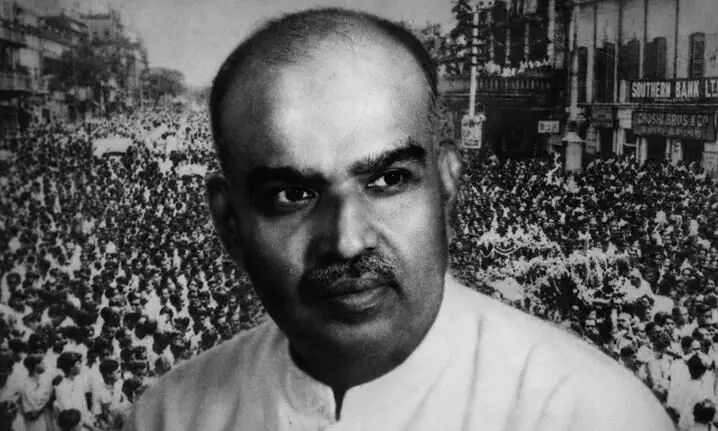
From the struggle over Jammu & Kashmir to the creation of West Bengal, the life and sacrifice of Dr Syama Prasad Mookerjee continue to shape India’s political discourse
“…I am not writing to you to seek any consolation. But what I do demand of you is justice. My son died in detention—a detention without trial… You speak of the affection you had for him. But what prevented you, I wonder, from meeting him there personally and satisfying yourself about his health and arrangements?” wrote Jogmaya Devi, on July 4, 1953, in reply to Pandit Nehru’s condolence message on the death of Dr Syama Prasad Mookerjee.
Dr Mookerjee had died suddenly in Srinagar on June 23, 1953, a few days short of his 52nd birthday. Sheikh Abdullah, prodded and supported by Jawaharlal Nehru, had got Dr Mookerjee arrested and then clamped him into detention without trial for over 40 days.
Dr Mookerjee’s sin, according to them, was the audacity of his demand that the Constitution of India’s writ run over Jammu & Kashmir and that its people be equal beneficiaries of the rights and privileges that the Constitution of free India conferred on her citizens.
Sheikh Abdullah, pampered by Nehru, dreamt of a special status for Kashmir, a sort of “Sheikhdom”, with a separate flag, separate Constitution, and a separate “Prime Minister”. Dr Mookerjee emphasised the need for Jammu & Kashmir to be “gradually absorbed in the Constitution of India” like all other princely states.
In the Lok Sabha, on August 7, 1952, Dr Mookerjee predicted what would happen if this artificial division and barrier existed. “What you are going to do may lead to Balkanisation of India… may lead to strengthening the hands of those who do not believe that India is a nation but a combination of separate nationalities.”
A plethora of privileges, granted by the Constitution of India, were denied to the people of Jammu and Kashmir through the application of the vexatious Article 370. The state of J&K, for instance, was beyond the pale of the Supreme Court of India, a position that is unthinkable today. The Article was a temporary provision, and Dr Mookerjee, supported by a large number of right-thinking people and leaders, insisted that it must go.
Rahul Gandhi’s great-grandfather had other priorities and positions, and he connived to get Dr Mookerjee arrested and detained. When Dr Mookerjee fell ill, he was treated with disdain and subjected to neglect and pain. His friends and family were prevented from visiting him; his letters to his family, especially to his mother, were censured and held back; his colleagues were not informed of the aggravated condition of his health. They were not informed of his final hours or of his death until the dark curtain had fallen on the life of one of India’s brightest and most illustrious sons. Dr Mookerjee was then in the prime of his public and political life.
An obdurate and arrogant Nehru turned down all pleas for an inquiry into Dr Mookerjee’s death. Nehru said that he was satisfied that there was no foul play. An inconsolable and ailing Jogmaya Devi’s poignant final reply to Nehru still makes tears well up: “Your experience in jails is known to us. It was at one time a matter of great national pride with us. But you had suffered imprisonment under an alien rule, and my son has met his death in detention without trial under a national government…”
Syama Prasad died a martyr’s death. When he died, his only thought must have been the unity and integrity of India and the manner in which it could be preserved and protected. He cemented forever that unity by consigning himself to the flames. No other leader of his stature had died in this manner before or after him.
Leaders cutting across party lines who demanded an enquiry into Dr Mookerjee’s death were Jayaprakash Narayan, Purshottam Das Tandon, Hari Vishnu Kamath, M.R. Jayakar, Master Tara Singh, Sucheta Kripalani, Pandit Hriday Nath Kunzru, S.S. More, and others. Atulya Ghosh, the Congress President of West Bengal, and Dr B.C. Roy asked for an enquiry. But Nehru would not budge. It has always been the special privilege of the Nehru family to wear tight blinkers and pretend as if the world and opinions beyond them do not exist or matter.
One of Dr Mookerjee’s closest erstwhile colleagues in the Hindu Mahasabha, Barrister Nirmal Chandra (N.C.) Chatterjee, speaking in the monsoon session of the Lok Sabha, which discussed the death of Dr Mookerjee, spoke for countless others when he said:
“Far, far away from his family, far, far away from his friends, in the chilling atmosphere of a State hospital at Srinagar, died Dr Syama Prasad Mookerjee. But he died a hero’s death, a true martyr to the cause which he held sacred, the cause of India’s unity and integrity which he cherished all his life and for which he sacrificed his life… what adds poignancy to the tragic death is that one of the greatest sons of India was robbed of his freedom, not by a government run by alien usurpers, but by a government which was manned by the children of the soil. The greatest tragedy was that he was kept as a prisoner behind prison bars, without any trial, and he was treated like an ordinary criminal in spite of his serious illness because he loved his motherland deeply and passionately and because he sought, in his own way, to maintain the unity of the country and, if possible, to intensify and strengthen that unity and solidarity… The greatest menace to democracy is the feeling that a political opponent of the government can be liquidated in prison when he is held in detention without trial…”
In April 1947, N.C. Chatterjee had joined Dr Syama Prasad Mookerjee in steering the Hindu Mahasabha resolution in Tarakeswar, in Hooghly, that called for the creation of West Bengal. The two of them had seen many battles through; the most crucial among them was the formation of West Bengal.
In March 1947, Syama Prasad had publicly stated the demand for the creation of West Bengal. Throughout the first half of 1947, he “became the single most vocal spokesman for Bengali Hindus”, and gradually the majority of Hindu members, opinion-makers, thought leaders, and the Hindu public came around to his side in demanding the partition of Bengal and the creation of West Bengal. Even though he was the lone Hindu Mahasabha member in the Bengal Assembly, Dr Mookerjee steered the whole debate, influenced and shaped it, and led it both inside the Assembly and outside, on the streets of Calcutta and Bengal.
The last British Governor of Bengal, Frederick Burrows, a sworn enemy of Bengali Hindus and a committed ally of the Muslim League, complained that “Dr Mookerjee was a clever and unscrupulous politician” and that even though the “Hindu Mahasabha had failed completely to gain representation in the Legislative Assembly except for Dr Mookerjee’s own seat, they were good propagandists.” Burrows saw his and the Muslim League’s cunning proposal of a “sovereign and united Bengal” fall to pieces because of Dr Mookerjee’s valiant and clinical political mobilisation.
That a leader with such outstanding political and legislative abilities, with such a deft capacity to manoeuvre forces and shape circumstances, a leader who had saved his people from ignominy and statelessness and had championed the integrity of India, would meet such an end and fate was inconceivable. N.C. Chatterjee, who had seen it all, was thus best poised to express the mood of Bengal and of India on Dr Mookerjee’s death.
The Bharatiya Jana Sangh under Pandit Deendayal Upadhyaya, Balraj Madhok, and Atal Bihari Vajpayee never forgot Dr Mookerjee and his sacrifice. The BJP under Atal Bihari Vajpayee, L.K. Advani, Murli Manohar Joshi, and Narendra Modi never gave up on the causes—political and ideological—that were fundamental to Dr Mookerjee. For decades, despite being in the opposition and at the receiving end, the political party and movement that Dr Mookerjee had founded relentlessly persisted with his political ideals.
Today, as we observe Dr Mookerjee’s 73rd “Balidan Diwas”, in his 125th birth anniversary year, we look back to see him and his legacy triumph. By consigning Article 370 to history, Dr Mookerjee’s finest political heir, Narendra Modi, has offered the most lasting tribute to him. The Citizenship Amendment Act, conferring citizenship on persecuted Hindus who have taken refuge in India, has been passed and is now functional. It was an issue on which Dr Mookerjee had completely staked his political career.
To see the Congress wither away, confused and shrinking, is also a tribute to Dr Mookerjee’s politics and vision. The Nehru Congress, which had vowed to crush him and his Jana Sangh, is itself reeling under a series of crushing electoral defeats and ideological confusion.
The most moving tribute, however, is to see Syama Prasad Mookerjee’s party, the BJP, after decades of persistent struggle, emerge resoundingly victorious and form a government in West Bengal, his birthplace. On his 125th birth anniversary, that political triumph, in a sense, immortalises his legacy and reinstates it in the heart of a homeland he had helped create and shape.
Source: https://www.millenniumpost.in/opinion/triumph-of-a-political-legacy-665221