Unravelling of a Puncturing Memoir
- By : Anirban Ganguly
- Category : Articles
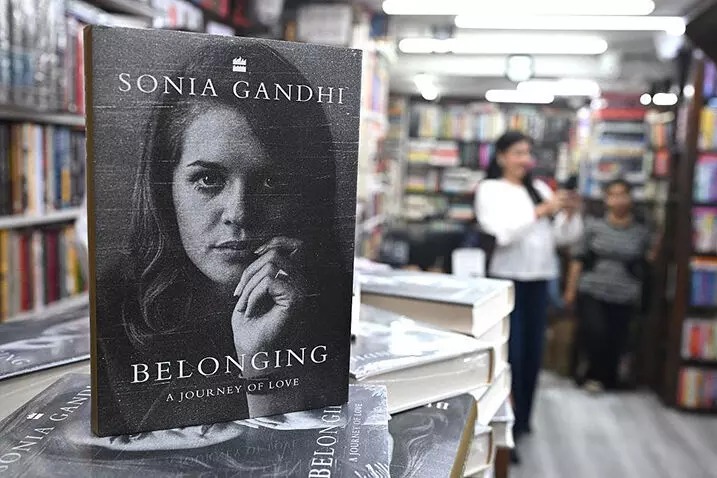
Sonia Gandhi’s memoir ‘Belonging’ has revived questions over selective recollections, omitted relationships and the political history left unexplored
Had Sonia Gandhi not been the controller of the Congress and had not a Congress drum-beaters’ association been at her service, her just-released narration would have sunk without a trace.
These are still the early days; the book will eventually sink with no recall or citation value for the serious scholar and reader of Indian political history. Apart from it being very poorly edited, Sonia Gandhi’s memoir doesn’t say anything new. One wonders whether Mrs Sonia Gandhi can claim to be its author.
Coming from someone who has lived in India since 1968, her perspectives and observations are shallow and callow. Sonia Gandhi clearly displays a slightly refined version of Katherine Mayo’s understanding of India. If not a gutter-inspectors’ report, Sonia’s “Belonging” will certainly qualify as a gazetteer’s record of how a district or municipality evolved over the decades.
Dhirendra Brahmachari and his antics and proximity to the family find one paragraph, but Anandamayi Ma is reduced to just one sentence, her proximity to Indira Gandhi not discussed. One does not find J Krishnamurthi, Indira’s one-time spiritual mentor, especially in her last years, mentioned, nor does one find The Mother of Pondicherry, to whom Indira would often turn, mentioned in the book.
Knowing Sonia’s ignorance of India’s spiritual traditions, it doesn’t come as a surprise. But even that which she knows very well was intimately associated with her, she doesn’t mention. One doesn’t find a trace of Sonia Gandhi’s family friend “Quattrocchi” in her memoir. Isn’t that gross injustice to the memory of a friend who stood by the Gandhis through thick and thin? To have a “best-selling” memoir not mention Gandhi’s “best-friend” is an unparalleled act of betrayal.
After being ignored for decades, after having been spoken of as a footnote, Feroze Gandhi and his family suddenly find mention in Sonia’s memoir. Feroze was marginalised, demonised, relegated to the margins of the Nehru-Gandhi story. Sonia thought it convenient to manufacture the closeness that the family continued to maintain with Feroze’s family long after his death.
One is reminded of journalist Bertil Falk, Feroze Gandhi’s biographer, who wrote of how Indira Gandhi “gave her husband no credit whatsoever for the important work he did for the development of parliamentary democracy.” He lamented how the Nehru-Gandhis “have refused to appreciate the tradition of democratic attitudes of the kind Feroze stood for.” The sudden recognition of Feroze, by the Nehru-Gandhi clan which had forsaken him, is artificial and stinks of opportunism.
For decades after she was married into the Nehru-Gandhi household, Sonia, by her own admission, had kept her Italian passport. Why? Was it not a serious breach of security and privilege? One of the closest members of the Prime Minister’s household lives on in close proximity as a foreigner? The lame excuse she gives, knowing that she would be expected to speak on this issue, is that holding on to her Italian passport enabled her to visit her parents without filling in many forms! Can anyone, in their right senses, buy this argument? She glosses over the entire episode, attempting to minimise or downplay her deliberate and intended rejection of Indian citizenship for decades.
S Gurumurthy, editor of Tughlak, had exposed Sonia Gandhi’s intentional obfuscation on her citizenship. Gurumurthy pointed out how in 1968, after marriage, Sonia did not apply for Indian citizenship but filled in an application for permission to stay as a foreigner in India for five years. This rigmarole of a five-yearly foreigner’s permit continued till April 1983, by when she was certain that Rajiv Gandhi would succeed Indira as her political heir. So much for her belonging. Between 1973 and 1978, she continued to hold on to her Italian passport. These were tumultuous years for Indira, especially the “Emergency” period. Had Sonia planned to leave India, in case things turned too hot to handle for Indira Gandhi?
The book throws up certain interesting dimensions. Let us see one of them. Kashmiri Pandits are mentioned in terms of their culinary uniqueness but their traumatic exodus, displacement and genocide is not mentioned by Sonia Gandhi. As if she were speaking as the “High Representative” of an international human rights body trying desperately to remain neutral, Sonia speaks of the Indian state cracking down hard and rendering the “atmosphere oppressive.” Her publishers must have advised her that this bit was necessary for her stuff to sell on international racks.
Sonia claims she was pained on seeing what had happened to the beautiful Valley. Of all the pain that she saw in Kashmir, not once does she condemn the violence wreaked by Pakistan-trained terror groups on Kashmiri Pandits, nor does she commiserate with them.
Sonia’s memoir has punctured and exposed her reality more than it has explained. There are many gaping and convenient holes and howlers in it.