PM Modi Reignites India’s Civilisational Sense Through Chola Legacy
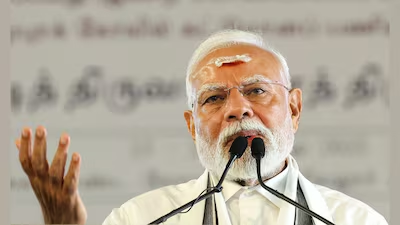
PM Modi spoke of the Chola empire as being the ‘cradle of democracy”
Prime Minister Narendra Modi’s tribute to the civilisational legacy of the Cholas was a significant and a profoundly symbolic moment for India as a whole. It concretised India’s civilisational aspirations to emerge as a great and decisive power in the comity of nations. That aspiration is legitimate for any nation or people which have existed, on a civilisational scale and proportion in the past.
The mighty Chola Temple of Gangaikonda Cholapuram has stood for a thousand years signifying that aspiration. It was an aspiration that led India, in the Chola era, to become master of the oceans and to disseminate her philosophy, thought, culture and coveted products across the Far East.
Diplomat-historian KM Pannikar, in his analysis of the ‘Determining Periods of Indian History’, argues that there “are some periods which shape the course of the future more than others, when events of far-reaching importance are crowded together so that the centuries that follow seem to be working out the ideas generated at that period…Also, it may happen that discoveries, achievements or decisions taken at such a crucial period mark so definite a change as to give a new character to the ages that follow. These are the determining ages of the history of a country, a region or a civilisation”.
The Chola era was certainly a “determining period” in the flow and evolution of Indian civilisation. The apogee then achieved had a far-reaching and multifaceted impact. It was an impact that was not confined to India but was spread across a vast region covering large parts of Southeast Asia and the Far East.
The Chola Empire’s spread and influence contributed to a unique synthesis and blending which enabled the evolution of a rich cultural and religious diffusion across Southeast Asia in which Hindu deities such as Shiva and Vishnu were central and defining. One is reminded of the words of that profound scholar of India’s civilisational past, D Devahuti, who argued that the spread of Indian culture happened through a “continuous flow of forceful ideas, and institutions”. The Chola era ensured a continuous flow of ideas and of institutions that had a lasting impact, visible even today.
As one heard PM Modi speak, one was reminded of the words of Gurudev Rabindranath Tagore, spoken a hundred years ago, “Do you know your own mind? Your own culture? What is best and most permanent in your own history? You must know at least that, if you are to save yourselves from the greatest of insults, the insult of obscurity, of rejection. Bring out your light and add it to this great festival of lamps of world culture.”
While speaking on the greatness of the Chola legacy, PM Modi was, as if asking us similar questions, asking us to rediscover these defining epochs that shaped our civilisational consciousness of the past.
For decades after independence, the “best and most permanent” in our history was ignored, omitted and suppressed. Eras recalling which would generate a collective national pride and self-esteem were relegated to the margins or dismissed as over-readings and false projections. Take the case of those legions of Indian scholars, in pre-independent India, who painstakingly traced sources and tracked new findings to establish the impressions of civilisational India left behind in lands that lay beyond India. However, in a free India these scholars, historians and thinkers, each formidable through their own achievements, were forgotten.
The saving of ourselves from a history of rejection and insult that colonisation brought in its wake, the talking back that could be done, standing on legacies such as the Cholas was not done. The Chola legacy could certainly reinstate that civilisational sense and consciousness and yet, successive governments, especially in Tamil Nadu, ignored its symbolism and its pan-India appeal. It is an appeal that can also move the vast Indian diaspora across the same region that came under the Chola spell in the past.
The Bay of Bengal was referred to as the ‘Chola Lake’ – Chola Samudram, because of the Chola control of sea routes and trade. The Chola empire was truly civilisational in nature. Its expanse, its reach, its cultural spread and trade outposts turned it into a formidable power and presence across India and vast swathes of Southeast Asia. The Cholas also played a significant role in the spread of civilisational India’s cultural footprints, leaving India’s cultural and religious expressions and traces all across this region.
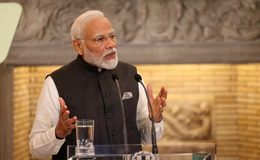
While addressing the Adi Thiruvathirai Festival at Gangaikonda Cholapuram, PM Modi made several significant remarks about the essence and the foundational ideals of the Chola empire. These significance from the past must drive our present national quest for the rise of a civilisational India. The Chola age was indeed a golden era of Indian history. PM Modi spoke of the Chola empire as being the ‘cradle of democracy”. He was alluding to the unique Chola era Utthiramerur inscriptions, in Kanchipuram, which elucidated the democratic rights and duties of the people, of the elector and of the elected, a thousand years ago, making it the first such a democratic document. In many ways Rajendra Chola can be considered to be the first global Indian monarch. Military, naval and cultural strength defined the reigns of Rajaraja and Rajendra Chola.
In his classic ‘Hindu Colonies of the Far East’, RC Majumdar observes how Rajendra Chola controlled ports along the entire East Coast of India, and of how the “mastery over the ports of Kalinga and Bengal gave the Chola king well equipped ships and sailors” which could ply across oceans and establish Chola presence and outposts. The Chola empire’s control, under Rajendra Chola, of “almost the whole volume of maritime trade between western and eastern Asia” and its control of regions across Sumatra, Malay peninsula, and Kedah, known in ancient Tamil lore as Kadaram – earning him the sobriquet of “Kadaram Konda” – one who has won Kadaram, remains a significant and historic record of Chola naval prowess.
While listening to PM Modi’s inspiring address on the essence, the richness and the enduring grandeur of the Chola legacy, when he spoke of the “Chola heritage, deeply rooted in unwavering devotion to Lord Shiva” as having become “immortal,” one could not but help think that had it not been for the Chola impact, civilisational India’s presiding deities Shiva and Vishnu would not perhaps have become integral to the civilisations of Southeast Asia. Several leading scholars have attested to the spread of the cultural ideals of civilisational India through the medium of Shiva and Vishnu.
Raghuvira, a leading scholar-philosopher of civilisational India observes that “Visnu and Siva have a long history, both in India and outside India” and of how “they have inspired mighty monuments in brick and stone, in bronze and ivory and in the fashioning of hearts and actions of men”. In Kedah – Kadaram, for instance, KA Nilakanta Sastri, writes of the traces of a Shiva temple whose architecture and style represented the transition from Shiva temples found in South India to those which eventually evolved in Java. PM Modi’s reiteration of the centrality of Shiva worship in the Chola era, brought these links to mind. The closing years of Rajendra Chola’s reign, Sastri points out, “formed the most splendid period” of the Cholas, “the extent of the empire was at its widest and its military and naval prestige stood at its highest.”
Intense worshippers of Shiva, the Cholas were also patrons of Buddhism. RC Majumdar records, from Chola inscriptions, that in or around the 21st year of Rajaraja Chola’s reign, at the start of the 11th century, king of the Sailendra empire, around present-day Sumatra, Chudamanivarman, “commenced the construction of a Buddhist Vihara at Nagapattana, modern Negapatam” [Nagapattinam], when a village was granted by the Chola king for its upkeep.” King Chudamanivarman, “died shortly after, and the Vihara was completed by his son and successor, Sri-Maravijayottungavarman.” The symbolism of a mighty Indian monarch, an ardent Shiva worshipper, granting villages for the construction and upkeep of a “Buddhist sanctuary, erected in India by a Sailendra king”, was significant.
The deepest symbolism was when PM Modi brought the sacred water of Ganga from the north and offered it at Gangaikonda Cholapuram. It was a reiteration of the fundamental and essential unity of India, the civilisational state. The same act in the past, of Rajendra Chola’s expedition to the north, to the banks of Ganga in Bengal, and the march back to his capital, of his erecting the “liquid pillar of victory” – “Jalamayam Jalasthambham” in the “form of the tank of Colaganga” was an unprecedented moment in the history of civilisational India. PM Modi’s reiteration of that civilisational act from the past, was a reiteration of the fundamental unity of India – cultural and spiritual, which remains undiluted and unbroken. For any nation aspiring to recover its civilisational status and self, such moments are assertively reinvigorating.
Of the Chola era, its most famous chronicler Nilakanta Sastri writes, that it was the “most creative period” in the history of South India, during which “in local government, in art, in religion and letters, the Tamil country reached heights of excellence never reached again in succeeding ages”. The height achieved in maritime activity and foreign trade, was also unprecedented. Narendra Modi at Gangaikonda Cholapuram, was redirecting our collective consciousness towards that past, with the intent of letting its memory and sense propel our future quest towards a comprehensive national and civilisational resurgence.