Politics of Self-Alienation versus Politics of Service
- By : Anirban Ganguly
- Category : Articles

The general election of 2019 is about six months away. We have reached the last mile, five years of unrelenting action, of undiminished ideation, of indefatigable implementation is completing a first full circle. The struggle between the “politics of self-alienation” and the “politics of service” is also intensifying in this last leg. Subversion, instability, abuse, lies, deceit and false propaganda are some of the instruments in this struggle. Those whose politics stand on self-alienation are taking recourse to these.
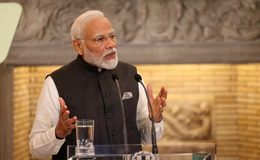
The ascent of Prime Minister Narendra Modi has meant the preponderance of the politics of service and of self-discovery; it signified the slowing down of the politics of self-alienation that had hitherto dominated India’s collective political consciousness in the decades that followed independence. In the last five years Modi has attempted to articulate, structure and draw an Indian grand narrative and he has based his entire effort on the discourse of the politics of service.
The politics of self-alienation is best described by Ram Swarup, one of the pre-eminent political philosophers of post-independent India, who describes it as “dogmatic and sloganised.”
The politics of self-alienation, argues Ram Swarup, “stirs up regional and communal differences and uses minorities in order to perpetuate a party or dynastic rule, or to set up a dictatorship of one kind or another. It holds common people in low estimation…It regards them as backward, superstitious, ignorant, illiterate. This view gives rise to its own politics of fraud, force and imposition…” Such a politics negates any effort at creating a grand narrative for India. The politics of the communist parties and of the Congress – both in the past and the present – exactly fits into the description of the politics of self-alienation.
Prime Minister Modi’s ascent in 2014 posed a formidable challenge to this brand and texture of politics, which for decades, had burdened and convulsed India. Rahul Gandhi’s Congress continues to resort to it having mastered the politics of fraud and force while some other parties like the Trinamool Congress in West Bengal, at a regional level, have mastered such a politics. The communist parties, in their heydays, were adept at peddling the politics of self-alienation and the Maoists-Naxals and their intellectual drumbeaters continue to perpetuate it.
The Rahul Gandhi led Congress is leading the charge of the “politics of self-alienation.” A party of the privileged and led by the privileged with a shrinking base, it has generated social tensions, has worked to erode institutional credibility and has repeated lies ad nauseam to derail our national march towards self-reliance.
Prime Minister Modi, on the other hand, represents the “politics of service.” Such a politics, in the words of Ram Swarup, “requires the capacity to see in common people, even in the midst of their poverty, a new dignity and beauty, new qualities of the mind and the heart”, such an approach, he argues, “makes us give them due respect and honour; this alone develops in us those qualities of humility, tolerance and understanding, so necessary for any deeper work.” Modi’s governance narrative emphasises on ushering in a “new dignity” for the marginalised, it has aimed at actualising that dignity.
The mindless call for “Modi Hatao” thus is being given by those who thrive on the “politics of self-alienation”, for them “politics of service” is claptrap, for Prime Minister Modi it is an article of faith.