With farsightedness, Syama Prasad called to link education and industry
- By : Anirban Ganguly
- Category : Articles

The interest in the life and times of Dr Syama Prasad Mookerjee is increasing by the day. Not only the fortnight between his birth and death—June 23 (1953), the day he died in mysterious circumstances in Srinagar, and his birth anniversary falling on July 6 (1901)—but throughout the year there is an increasing interest, especially among youth.
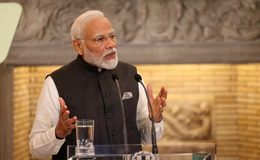
What is fascinating about his life is that despite being short, it had so many dimensions. In each of these areas of human action, Syama Prasad excelled. Prime Minister Narendra Modi in a rich and profound tribute to him on June 23, while speaking in Madhya Pradesh, spoke of three cornerstones in the life of Syama Prasad—he referred to ‘vidya (education), vitta (finance/economy), vikas’.
What is fascinating about Syama Prasad’s life is that despite being short, it had so many dimensions. In each of these areas of human action, he excelled.
Indeed, Syama Prasad’s life revolved around these. The first station of his working life, in which he excelled, was as the youngest vice-chancellor of the University of Calcutta at the age of 33. As V-C, Syama Prasad initiated a number of reforms and changes in the university, focused on the growth of Indian languages, on scientific training, agricultural education, research in Indian history and civilisational studies, initiated Chinese and Buddhist studies and invited Gurudev Rabindranath Tagore to deliver the convocation address in Bengali—for the first time in the history of the university or British India.
Even in later years, Syama Prasad continued to have a close interest and association with leading educational and research institutions in the country such as the Indian Institute of Science in Bengaluru, among others. His convocation addresses delivered to universities across the country from 1930s to 1952 are full of deep thought and wisdom. Syama Prasad advocated innovation and autonomy in higher education, insisted on the need for original research, and argued that each university should develop its own areas of focus.
His call to strengthen primary and higher education, his call for the need to link education and industry are dimensions which continue to be relevant today. His formidable reputation as an educationist and an uncompromising nationalist, led the Mother of Sri Aurobindo Ashram at Puducherry select him as the chairman of the Sri Aurobindo Memorial Convention, held in April 1951 to establish a university that would perpetuate and disseminate the vision of Sri Aurobindo while imparting and implementing a new vision of education.
Syama Prasad’s administrative acumen and political sagacity came to the fore when he assumed charge as Finance (vitta) Minister of Bengal, deftly balancing a coalition government with the Muslim-dominated Krishak Praja Party, and astutely keeping the Muslim League at bay and neutralising its capacity to inject the poison of communal politics, handling the colonial administration bent on trying to sabotage or wreck the experiment and all the while effectively carrying out his administrative duties.
His vision for vikas was best seen in his role as free India’s first minister for industry and supply from 1947 to 1950. This was the period when he worked to lay India’s industrial foundation. The first industrial policy of independent India laid out in 1948 ‘reflected his ideas and vision’. His goal as minister was to ensure that in basic industry and infrastructure India must become self-reliant. Syama Prasad wanted India to develop big industry as well as focus on MSMEs, cottage industries, handloom and textile. His tenure as industry minister saw the laying down of the foundation of cottage and small-scale industries.
In all his actions, he was inspired and directed by one overweening and unshakable impulse—that of seeing India become once more great, self-reliant and conscious of her strength and civilisational wisdom.