NEW IDEA OF INDIA HAS RATTLED LEFT-LIBERALS
- By : Anirban Ganguly
- Category : Articles

The Prime Minister has talked of replacing poverty with prosperity, discrimination with equality-equity, dirt with cleanliness, unemployment with employment and opportunity, and despair with hope
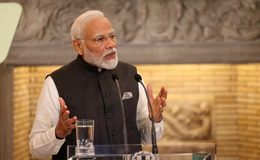
Not many covered Prime Minister Narendra Modi’s speech at the BJP national council meet at Kozhikode on September 24-25, in its entirety. Some sections, driven by a litigant historian of the Leftist vintage who has made a devil out of almost all our national stalwarts — Sardar Vallabhbhai Patel, Syama Prasad Mookerjee, VD Savarkar et al — got stuck with Modi’s mention of Pandit Upadhyaya’s exhortation to refrain from “Puraskar”, “Tiraskar” and focus instead in making “Parishkrit” the denominational relation between Hindus and Muslims in India.
That relation needs to be refined, need to sublimated and evolved to a level of greater cohesion, was what Prime Minister essentially wished to convey to the rank and file of the part. Any balanced mind would have easily read in the Prime Minister’s message this dimension of holism. All those who have been exposed to the thoughts of Pandit Upadhyaya, to the ways and exhortation of Prime Minister Modi, could well internalise his direction and suggestions.
In fact, throughout his election campaign across the country, throughout his tenure as Chief Minister of Gujarat, the real Narendra Modi and not the stereotyped mannequin created by a certain section in the media and academia to suit their political objectives, has in fact always exhorted on this need to fight common national enemies of inequity, of marginalisation, of lack of resources and of opportunities and of striving in unison for our overall integral national development. The articulation of ‘India First’ in various fields of action fundamentally stems from this deep-rooted belief that has evolved over the years during his peregrinations across India when he mingled and examined at close quarters the real and essential India and felt its pulsating diversity and challenges.
In fact, Modi poses a major challenge to two linked thought-cartels. One of these has always worked and thrived within India but has always pushed and peddled extraneous agendas within the country. It naturally irks this section when one exhorts the people to national greatness without resorting to demagoguery or bigotry. Such a positive exhortation inflates this section’s arguments and narratives. The other category that is most disturbed with Modi’s self-renewing faith in India and Indians and his indefatigable thrust on re-instilling a deeper and abiding faith in her civilisational quest while also trying to situate her in the larger global order, are those who have always generated a disdain and for the very vision of civilisational India and who have incessantly worked to generate a negation, denigration and hatred towards the idea of the nation, of civilisation and of inherited wisdom and values.
This category has intensely worked to create Indians who spite at the very idea of India and revel in announcing its impending demise —a nd in doing so, are showered with accolades and approbation. As Bibek Debroy succinctly put it recently, “If I am not proud of my country it only means I am not proud of myself.” This category has worked overtime to prevent the evolution of this sense of pride in our country and consequently in our very selves. For both these categories, thus, Modi poses a challenge, a challenge they are unable to really handle.
Both these categories have also projected the emotions of patriotism and of nation-first as a diabolical plea for oppression, for suppression and marginalisation. But it is only their asphyxiation that is reflected in such reductionism, for they thrive only when India is at a low edge or when people are unsure of themselves. It is this psyche of uncertainty or inaction that Modi has repeatedly challenged and, therefore, it profoundly unsettles those who prefer uncertainty and thrive on conflagration and subterfuge. It is these who have repeatedly generated a divisive discourse, suppressed a legitimate quest at national greatness and have spewed derision on all those who have called for India to regain a certain position of notice in the comity of nations.
The BJP national council meet was in line with the vision of governance and of India that Pandit Deendayal Upadhyaya had envisaged through his political philosophy of Integral Humanism. In fact, the national council meet at Kozhikode was historic in many ways. It announced the celebrations of Pandit Upadhyaya’s centenary and pledged to undertake a countrywide effort to spread his integral and uniting philosophy.
The Prime Minister’s eight-fold sutra for national growth, development and integration that he articulated in the course of his speech at the council, encompassed the entire gamut of action and activities that he has initiated in order to push India confidently striding 21st century. The sutras give a clear direction for action that is needed to raise India to the next stage as a leading and a prosperous power. The Prime Minister talked of freeing India from poverty and replacing poverty with prosperity, of replacing discrimination with equality-equity, of replacing dirt with cleanliness, of replacing unemployment with employment and opportunities, of replacing despair with hope, of restoring the dignity of women by ending exploitation, of replacing corruption with transparency and of replacing injustice with justice.
The fulfilling of the Eight-fold sutras have the capacity to define the approach to our polity and governance, it has potential to appeal to every conscious citizen and weave around it a national ethos that will push India out of a collective atavism of the last nearly sixty decades. By articulating eight sutras before a mammoth gathering on the beaches of Kozhikode, the Prime Minister has re-affirmed his own commitment to achieving these. The message of samriddhi and suraksha also emerged.
At a time when most political parties are either rudderless or suffering from internal squabbles, dynastic debilitation and plain directionlessness, this reiteration is indeed hope-generating and is the result of a sustained political and ideological movement and dialogue. While some leaders — self-style messiahs of the poor who have no qualms in divesting them of their hard earned resources in order to propitiate certain groups, like Mamata Banerjee did in Bengal when she went into a shell and clamped up, having ensured that lakhs of her voters and citizens lose their savings — indulge in expletive-laden political action, Narendra Modi continues to redefine the dimensions of governance and of India’s rise. His message from Kozhikode resonated with the spirit of India — the commitment to work for her self-reliance and the ultimate triumph of the vision of her that nationalists across generations have seen and aspired for.