No Dictate Can Dilute Appeal of Motherland Worship
- By : Anirban Ganguly
- Category : Articles
A number of inane debates are being forced on our national life today—debates that would have made Indian revolutionary nationalists and thinkers from the past cast an eye of dismay. None of them, for example, would have ever countenanced the possibility of having a debate on whether ‘Bharat Mata ki Jai’ is a legitimate exhortation to further bind the felt unity of national life and of the collectivity.
Moulvi Liaquat Hossein, venerated activist of the Swadeshi era, who, at an advanced age took to the streets of Calcutta to protest the partition of Bengal and insisted on chanting Bande Mataram and hailed the motherland as a form to be adored, worshipped and protected, would never have anticipated the inane debate that is being sought to be generated by a motivated section. For Hossein, the motherland appeared a vibrant entity, with a shared space of memories, of traditions and of living that needed to be reclaimed from a deracinating colonial yoke.
Abdul Rasul, president of the Barisal Provincial Conference in 1906, for example, led a march defying the ban on chanting of Bande Mataram and ‘Bharat Mata ki Jai’. Joined by Surendranath Banerjee, Sri Aurobindo (then professor Arvind Ghose) and others, Rasul led the march which was eventually brutally broken up by the police. The struggle was not with what to chant or on what to desist from chanting, the struggle was rather for the right to worship and celebrate one’s mother country and to work for her well-being and prosperity in all freedom and liberty. It was the vision of the motherland that, for instance, repeatedly inspired Subramaniam Bharati to compose his revolutionary poems, which continue to inspire. It is only a sense of a shared civilisational space, an attachment to traditions and to those, who in the past, have struggled to preserve and pass these on to newer generations, which can bind oneself to the motherland.
One of the first things that Marxist historiography does is to try and dilute this felt emotion and connect to the space one has grown up into and a space that has been shaped by one’s ancestors, however far and remote. For the Communists, the ultra-leftists and jihadis—all of whom have struck an alliance today in the name of “azadi”—the idea of the mother-country is never sacrosanct; it is in fact non-existent. The one binding objective that links these regressive ideologies is to see an India that is fragmented, an India where an overweening national unity is non-existent and an India where each section struggles to oppress the other. In their attempt to give shape to such a rubric, they oppose and rant against any chant or action that re-affirms national unity and reiterates the vision of the motherland as a sacred entity.
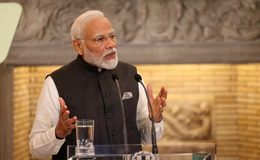
Prime Minister Narendra Modi being welcomed at TCS Riyadh with chants of ‘Bharat Mata Ki Jai’, in a sense settled the issue, divorcing the debate from a denominational dimension. It is a chant that had inspired and continues to inspire generations of Indians regardless of their religious belief. No dictate or directive can dilute the appeal of that re-invigorating cry. Those who indulge in trying to mentally and physically limit its reach and power of galvanising minds and hearts are in fact indulging in a debate which has no intellectual moorings or foundation.
The motherland as a form for worship and propitiation is a thought that has propelled countless revolutionary nationalists to resist colonial domination and to absorb the excruciating pains of extreme torture and hardship. Hossein was thrown in prison, shackled and confined to a solitary cell. It is his memory and that of countless others like him that have essentially lent strength and shaped the aspiration of motherland worship.