Tapping Civilisational Ties to Avert Historic Crisis
- By : Anirban Ganguly
- Category : Articles
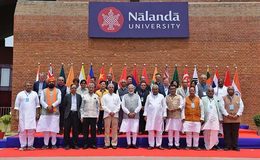
Over 21 countries represented by leading scholars, teachers of spirituality and religion, venerable bhikkus, political leaders and former heads of state converged for the Global Hindu Buddhist Initiative on Conflict Avoidance and Environmental Consciousness in New Delhi early this month. Pointing to a deep civilisational challenge or crisis, the initiator of the conference, the Vivekananda International Foundation, has rightly argued that the world today is at war—a war that was not overt but one that’s ‘no less harmful’. The conference was convened to deliberate and initiate a dialogic process for a way out of that crisis and conflict by deriving light from the Indic or Dharmic civilisational indices.
The Énoncé de Vision, in a pithy description of the new dimensions of conflict and imbalance, referred to the “myopia of profits and an ego that craves superiority over our fellow brethren” leading to a “life of wanton devastation”. Such a state of being, it argued, was making humanity go through “what is perhaps the most violent time in history”, thus putting at stake not “just our lives and values but the environment that sustains us, and, by extension, therefore, the very future of our planet”.
Leading thinkers and practitioners urged India to utilise her vast civilisational knowledge and experiential repositories to salvage the situation and emerge with frameworks of engagement based on our millennial wisdom that emphasise the need for balanced consumption, balanced living and an attitude that essentially aimed at avoidance of conflict and emphasis on dialogue and growth of Ananda.
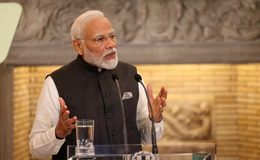
Prime Minister Narendra Modi, while inaugurating the convergence, articulated India’s civilisational aspirations and potential calling for strengthening bonds of thought, culture and spirituality, which bind the participating nations. He talked of how the world was afflicted with various conflicts. There are conflicts between humans, religions, communities and nation-states and between states and non-state actors that saw the latter controlling large territories and “unleashing barbaric violence on innocent people”. Another type of conflict is between “nature and man”, “nature and development” and “nature and science”. He dwelt on how Hinduism, Buddhism, Shintoism, Taoism and Confucianism held keys to restoring the lost balance between nature and man. PM Modi talked of the need focus on “climate justice”, instantly infusing into the ongoing climate debate a new dimension that not only diversifies the discussion but also elevates it.
Infusing further depth into the discussion, Modi spoke of the need to engage in dialogue inspired not by ideology but the strength of philosophy. “The essence of philosophy,” he argued, “is that it is not a closed thought, while ideology is a closed one. So, philosophy not only allows dialogue but it is a perpetual search of truth through dialogue.” The underlying thought-base of the entire exercise was laid and strengthened in Bodh Gaya where Modi referred to the Hindu-Buddhist India or Buddhist-Hindu India and mentioned Sakyamuni as the Crowning Jewel of India, how without him an Asian Century can never come to fruition. He called for intensifying these age-old bonds of civilisation and of thought between India and her past civilisational partners. The conference saw a video address by Japanese PM Shinzo Abe, who spoke of the common civilisational bonds between India and Japan tied with the golden thread of Buddha’s message. The exercise was a veritable civilisational convergence in the capital of India, a sea of thought, of world-views, of ways of being and living that had gathered and coalesced to engage in a genuine dialogue.
The civilisational journeys, which Bodhidharma and Acharya Santarakshita began from Bharat in the past, received a new momentum and direction from this congregation… the beginning of a civilisational journey in our times.