India of the Ages is Rising, Signalling a New Twilight
- By : Anirban Ganguly
- Category : Articles
The last one year since May 2014 has been a year of profound shift. Through a steady and sure movement forward, India’s rise as a civilisational state has begun. The advent of an epochal shift brings about the generation of ideas, of concepts, visions and actions that have defining capacities. The last year has seen many such actions and articulations, each, perhaps in its own way, having a deep impact on India’s ongoing directional change.
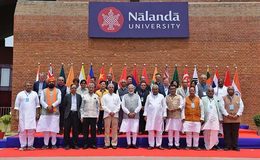
When heads of SAARC nations converged in New Delhi last May, to attend the swearing-in of the new government, it symbolised a new shift that could permeate the vision of SAARC. When PM Narendra Modi spoke of developing SAARC into a shared zone of prosperity, it heralded a new narrative, which aspired to bind the region closer.
The Prime Minister’s speech at the United Nations General Assembly in September 2014 signified for India a major shift on the world stage after a decadal slide. His call to recognise yoga universally and the immediate and overwhelming endorsement it received worldwide firmly and globally established the Indic way of life and re-affirmed the civilisational faith that the Indic way is the way to harmonious and cooperative global living.
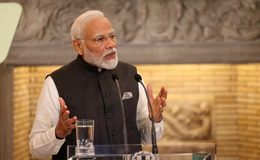
When Modi spoke at the Council of Foreign Relations in New York and argued that the need of the hour for the world was to work on the basis of a philosophy and not ideology, that “a country that works or moves in the shadow of philosophy sustains for a longer duration (and) Those who work with ideology will one day or the other topple” (or that) “Ideology has its limitations. Philosophy is unlimited. And that is why the philosophy of India that the entire world is a family, that’s the philosophy we are taking with us to move forward”, he introduced a profound philosophical position that was unique to Indic civilisational thought. It
signified a new source of inspiration for India’s action on the world stage.
The repeated allusion to the Asian century, to the rekindling and re-activating of civilisational linkages to make the Asian century a reality, the Prime Minister’s call for engagement between the rising powers of Asia, as when he made his historic speech at Tsinghua University during his just-concluded China visit, are also indicative of this profound shift in India’s self-perception and her perception of the world. The conviction that India can and aspires to shape the Asian century, that the century shall be defined by the rise of India and the formation of a multi-polar world order, have increasingly shaped her external outreach in the last one year.
Involving the diaspora as active stake-holders in the shaping of India’s destiny and in the consolidation of her standing on the world stage, the outreach to India’s past civilisational zones, be it in the Indian Ocean Region or the Asia Pacific, expressing the faith, as the Prime Minister did during Buddha Jayanti celebrations, that the creation of the Asian century can be done only with Buddha as its fulcrum and centre, have all initiated a deep redirection of forces and currents in the region and beyond. The effects of this recalibration are yet to be felt in its entirety.
Meanwhile, the faith that India has still something to do for herself and for humanity is being reinforced, as Sri Aurobindo wrote, nearly a century ago, “India of the ages is not dead nor has she spoken her last creative word; she lives and has still something to do for herself and the human peoples… And that which must seek now to awake is not an anglicised oriental people” but a collectivity, a civilisation that aspires for India to “recover her deeper self”.
Truly, it is a “new twilight” that we are living through, “not of an evening but a morning Yuga-sandhya”.