FORGING NEW TIES WITH AN OLD FRIEND
- By : Anirban Ganguly
- Category : Articles

Leading minds in Myanmar seem to acknowledge the way India has begun to look at her neighbours. They also expressed eagerness to be part of that change
A fortnight back, I visited Myanmar as part of a delegation to attend a dialogue hosted by a group of think tanks comprising of the India Foundation, Maulana Abul Kalam Azad Institute of Asian Studies, the Institute of Transnational Studies and the Myanmar Institute of Strategic International Studies — the leading think tank of the Foreign Ministry of Myanmar.
The two-day dialogue discussed the way forward together for India and Myanmar. It was striking to see the reservoir of goodwill towards India, at least among a section of leading intelligentsia in that country, who, recalling the past civilisational links and having lived through half a century of hiatus and distance between the two immediate neighbours, aspired to see the relations between our two countries re-forged and restructured to suit the evolving geopolitical realities of today.
The realisation that both have lost out in terms of cultural-civilisational renewal which include the entire gamut of trade, commerce, education, technology and people-to-people exchange, is now being articulated. Leading minds in Myanmar seem to acknowledge the paradigm change in the way India has begun to look at her neighbourhood and expressed eagerness to be part of that change or rather to be active partners in the new Asian march that is being heralded by that change.
That the past civilisational links continue to remain a point of convergence and bonding was evident during the interactions. A former professor of the University of Yangon recalled her days as a student in the university where Indian philosophy was taught and attracted a large number of learners.
“Not only Buddhism, we were exposed to Vedas, Upanishads, Puranas”, she recalled, and there “was always an eager crowd of students who looked forward to these classes.” Could these classes be revived, could India arrange to send books, resource material and scholars who would help in organising again such an academic initiative, was the question that was put before us with great eagerness. Some members also explained how the ordinary Myanmarese had forgotten India and there was need to have India festivals in Myanmar and vice-versa in order to renew the cultural touch at the grassroots.
Interestingly, such observations came in the backdrop of a growing realisation of the challenge posed by globalisation to local cultures — an issue that our counterparts from Myanmar repeatedly flagged — especially in those societies that were gradually opening-up after a long spell of isolation. Cultural co-option, the onslaught of cultural-homogenisation and the tendencies of cultural uniformity — though a long drawn process and at times barely perceptible on the surface initially — are some of the effects that culturally rich and sensitive societies are increasingly being bound to address. The Myanmarese strongly felt the need to address that dimension in their present national evolution.
A new energy and optimism was evident all around with a number of leading conglomerates having inaugurated their projects and established their footprints and yet amidst all these signs of economic activity the quintessentially Myanmarese age-old cultural imprint continues — the gentleness, deference towards women, the traditional attire, the proud safe-guarding and preservation of religious symbols and a tenacious adherence to the faith of the Sakyamuni as passed on through their ancestors continues. As the dynamic Indian Ambassador to Myanmar movingly put it, the “echoes of Emperor Ashoka’s message” was still heard across the length and width of the country.
On a visit to the century-old Durgabari and Devi temple at Yangon we saw locals, Indians and Myanmarese, offer their obeisance to a host of Hindu deities — symbolising the intermingling of centuries of cultural-religious-commercial exchange. Apart from wealthy Chettiar merchants of the past, a number of Myanmarese were also benefactors of these temples.
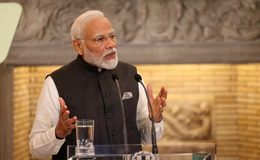
In his path-breaking visit to Myanmar, Prime Minister Narendra Modi spoke of India’s Eastern journey beginning on the Western boundary of Myanmar — the visit was an occasion to absorb the multi-dimensionaltrajectoire of that fascinating journey.