Bengal’s Evil Days Reflection of Power-Ability ImbalanceAnirban Ganguly
- By : Anirban Ganguly
- Category : Articles
Ancient Indian texts on governance had always a detailed section on the ethics which enjoined rulers to establish and perpetuate a value-based relation with their subjects. Rulers were clearly directed to be accountable and responsive to those they ruled. Such injunctions on their conduct in public life also succeeded in drawing an effective line to the notion of unlimited power that the sovereign was purported to enjoy. It created the system of checks and balance within the power structure itself.
The edicts also conferred on the subjects the power of rejection. Rulers who failed to nurture their constituents ceased to be sensitive to their needs, and who grew arrogant while presiding over a venal administration could be rejected or dethroned by the people. The ruled were not consigned to perpetually suffer misrule or valueless conduct. These may have been descriptions of ideal situations or circumstances, but the very fact that they were formulated point to the existence of a dynamic effort at evolving a discourse on ethics and a value inspired conduct in public life that was quite unique to the Indian civilisational spirit and discourse.
Alluding to such a position, the legendary K A Nilakanta Sastri, while discussing the deeper nature of Indian polity in his Gleanings on Social Life from the Avadānas (1945), argued that though these sections and texts may have been utopian in character, a little reflection shall show “that in fact these apparently impossible ideals exerted a tangible influence on the conduct of all truly great rulers of India”.
That there was a robust ethical tradition in the civilisational context is confirmed, among other sources, by the famed Utthiramemur inscriptions in Tamil Nadu, the first constitution to be conceived in India during the Chola epoch. The inscriptions clearly spoke of the rulers’ urge to see their constituents live a happy and prosperous life, in his opuscule, Elections in Tamilnad, noted epigraphist Dr R Nagaswamy, for example, observes that the inscriptions of Rajaraja Chola II, found in many parts of Tamil Nadu, specifically mention that his rule aimed at making every individual feel satisfied that he had a full, free, independent and happy life—“Ellorum tanitanniye vaalntanam ena manam mahilndu” says the Chola edicts. The edicts also insisted on transparency in governance and strictly barred those who violated people’s trust reposed in them. Two such injunctions suffice to provide an insight into the stringent demands: “Any elected member who accepted bribe was also permanently debarred from standing for elections” and one who “misappropriated any property” also faced disqualification.
The quest for evolving or sustaining an ethical framework of governance appears to have continued down to a later age as well. In 1923, C R Das, the celebrated Deshbandhu, and political philosopher Bhagavan Das presented before the nation An Outline Scheme of Swaraj. The proposal insisted that “every possible care should be taken to ensure that the people’s elected representatives shall be, not self-seekers, but seekers of the public welfare”.
It is ironical, to say the least, that some present day splurge-loving leaders, especially one rather unruly one from Das’s own state of Bengal, have thrown to the winds these very potent directives, which, if adhered to, in fact can only lend strength to one’s position.
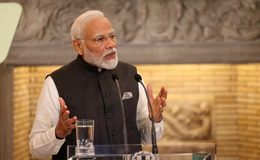
While our Prime Minister strives to revive and rework that ancient Indian ethical framework in our governance structures and mindset, Mamata Banerjee remains a symbol of negating these higher values and ideals in our national life. Hers is a clear case of what Dr S Radhakrishnan had alluded to, “when power outstrips ability, we will fall on evil days”.
Bengal’s evil days is a reflection of that imbalance.