Ancient Knowledge Society Must Inspire India of Today
- By : Anirban Ganguly
- Category : Articles
Teachers’ Day, being observed this year, perhaps for the first time, as a festival, is a great tribute not only to the philosopher-statesman in whose memory and educational contribution the occasion is commemorated but also points to a deeper civilisational dimension in India where education itself, in the days of yore, had occupied an exalted position. The just-concluded commemoration offers an occasion to look back at India’s past as a dynamic “knowledge society”.
In the ancient world, India had assumed the status of a civilisational beacon largely because of her standing as an advanced knowledge society. That seekers of wisdom came from far and wide, in order to soak in the river of Indian knowledge, is now an intrinsic part of our civilisational lore. When much of the Western world was still grappling with existential challenges, India had already evolved a wide, robust and vibrant education network.
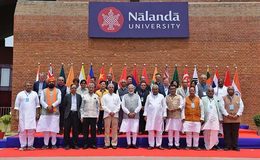
In his University of Nalanda, celebrated historian H D Sankalia referred to this when he wrote that as early as the “Upanisadic times, India had evolved a system of education which would stand comparison” with “similar organisations of the Occident known as ‘city schools’, ‘studium generale’, ‘university’”. It was generally out of this initial system that the later, widely admired, Indian educational super-structure evolved.
These ancient seats of learning not only attracted learners from across the ancient world but also sent out wise teachers—ācāryas—to other civilisations to impart the light of Indian knowledge. These ācāryas, eliciting great reverence from the people, eventually established themselves as knowledge lighthouses of their adopted regions.
Indian education flourished and held through with resilience, mainly because of a determined and unfailing collective support. Offering—dāna—made for the cause of education was considered to be the highest, and rulers vied with each other to found educational endowments— adhyāyanavrttis.
It is fascinating to read that despite the disrupting upheavals of subsequent centuries, the basic structure and approach of Indian education continued to hold. A January 1791 issue of the Calcutta Register and India Repository, for example, described the University of Nuddeah (Nadia) in Bengal. Even in a much whittled down state, the university maintained a formidable reputation with three colleges each “endowed with lands for maintaining masters in every science”. The system ensured that a shortfall was addressed from the “Rajah’s treasury”. Interestingly, the masters at the university not only had “stated salaries from the Rajah, for their own support, but also an additional allowance for every pupil they (entertained)”.
It was a deeply democratic set-up as well; students of little means but with keen academic interest, the journal recorded, were supported and not turned away, while those in “affluent circumstances” lived at the university on “their own expense without burdening the foundation”. The pattern or method of instruction was designed to invite and evolve a true spirit of enquiry, as the register noted, “When a student hears anything advanced, or expressed, that he does not perfectly understand, he has the privilege of interrogating the master about it. They give the young men every encouragement, to communicate their doubts, by their temper and patience in solving them.”
More importantly, a master who “lost his temper, in explaining any point to a student, let him be ever so dull and void of memory, absolutely (forfeited) his reputation, and (was) disgraced.”
But after this, rolled in the juggernaut of colonial education and the long night—uprooting and starving the intricate Indian educational eco-system and erasing the civilisational memory of a vibrant academic past.
“Guru Utsav” was an occasion to draw inspiration for the future from that inspiring past.