DEEP CULTURAL ROOTS BECKON US ALL
- By : Anirban Ganguly
- Category : Articles
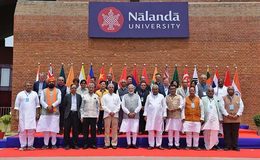
A re-imagined and re-awakened new Asian Order is in the making with Prime Minister Modi reaching out to the East and South East countries
It augurs well that over the past few months India has begun to look and act East with renewed vigour and commitment. India’s recent reaching out to the members of the Asean, to Myanmar, Vietnam and now to Japan is symbolic of its pledge to re-imagine and re-lay its age-old civilisational links with this crucial region and to infuse them with a new dynamism and vision for the creation of a restructured Asian Order.
Such a determined move towards reaching out to India’s natural civilisational allies often bring to mind efforts — past and present — made by scholars who have spent a lifetime re-configuring India’s cultural-philosophical contour as a great civilisational state. Be it Central Asia and beyond, be it the archipelago là-haut, India’s civilisational reach has always been multi-dimensional and multi-region.
In a study on the “Expansion of Indian Medicine Abroad”, French physician and Indophile Jean Filliozat pointed at such multi-dimensionality, when he wrote of how elements from Indian medicinal systems, especially Ayurveda, reached the Greeks and were incorporated in their medical lexicon. “We have several direct references”, argued Filliozat, “in the Hippocratic Collection to the borrowing of some Indian drugs and Indian medical formulas in Greece”. In the period of the expansion of Indian civilisation towards Central Asia, China, Indo-China and “Indonesia beyond the seas”, Filliozat wrote, “Indian Ayurvedic medicine has been one of the main matter of export, along with astronomy, religion and arts”.
The other iconic Western scholar of Eastern civilisation, Sylvain Lévi , in his ‘L’Inde et le Monde’ (1928) also referred to India’s reach, “l’étude des monuments et des inscriptions a montré dans l’Indochine et dans l’Insulinde des colonies hindoues fidèles aux arts, aux religions, aux oeuvres littéraires de l’Inde” (Study of monuments and inscriptions in Indo-China and Maritime South East Asia reveal the existence of Hindu colonies that remained faithful to the arts, religion and literature of India). Lévi read in the ancient world an Indian civilisation inspired world order, he saw India’s footprints far and wide, “de la Méditerranée à l’Océan Pacifique, les nations proches et lointaines” (from the Mediterranean to the Pacifique ocean, nations far and wide) revealed India’s civilisational reach), the countries that had preserved India’s civilisational footprints, came round together around India, as it were, and projected converging rays of light, at last lightening up the night that had long silenced or engulfed her civilisational memory, “un faisceau convergent de rayons sur la nuit muette de son passé”.
One such scholar who has untiringly studied India’s past in that converging light for nearly half a century is professor Sachchidanand Sahai, perhaps the only scholar of India’s civilisational reach in Southeast Asia to have successfully completed his thesis on the ‘Institutions Politiques et l’Organisation Administrative du Cambodge Ancien’ (The Political Institutions and Administrative Organisations of Ancient Cambodia), from the University of Sorbonne and under the guidance of the legendary scholar of the ‘Hinduisation’ of Southeast Asia, George Coedès (1886-1969). In his widely acclaimed and path breaking study, ‘Les Etats hindouisés d’Indochine et d’Indonésie’ (Hinduised States of Indochina and Indonesia) (1948, 1964) Coedès, referring to the civilisations of this region and their religio-cultural-societal expressions, argued that under their “apparent uniqueness, lies the imprint of the Indian genius” which give these countries “a family likeness and produces a clear contrast between these countries and the lands that have been civilised by China”.
Professor Sahai’s prolific academic quest, like that of his celebrated guide, has been dedicated to unearthing facets of that “family likeness” through a study of Hindu India’s civilisational achievements and expressions. In this he has dedicated a lifetime to travelling and mingling with the people and civilisations of Southeast Asia, making them his partners and co-seekers in this fascinating search of his.
His latest study, ‘Shiva Beyond India’, examines the widespread and influence of the parampara of Shiva worship in the archipelago and beyond. It promises to reveal a fascinating civilisational journey.